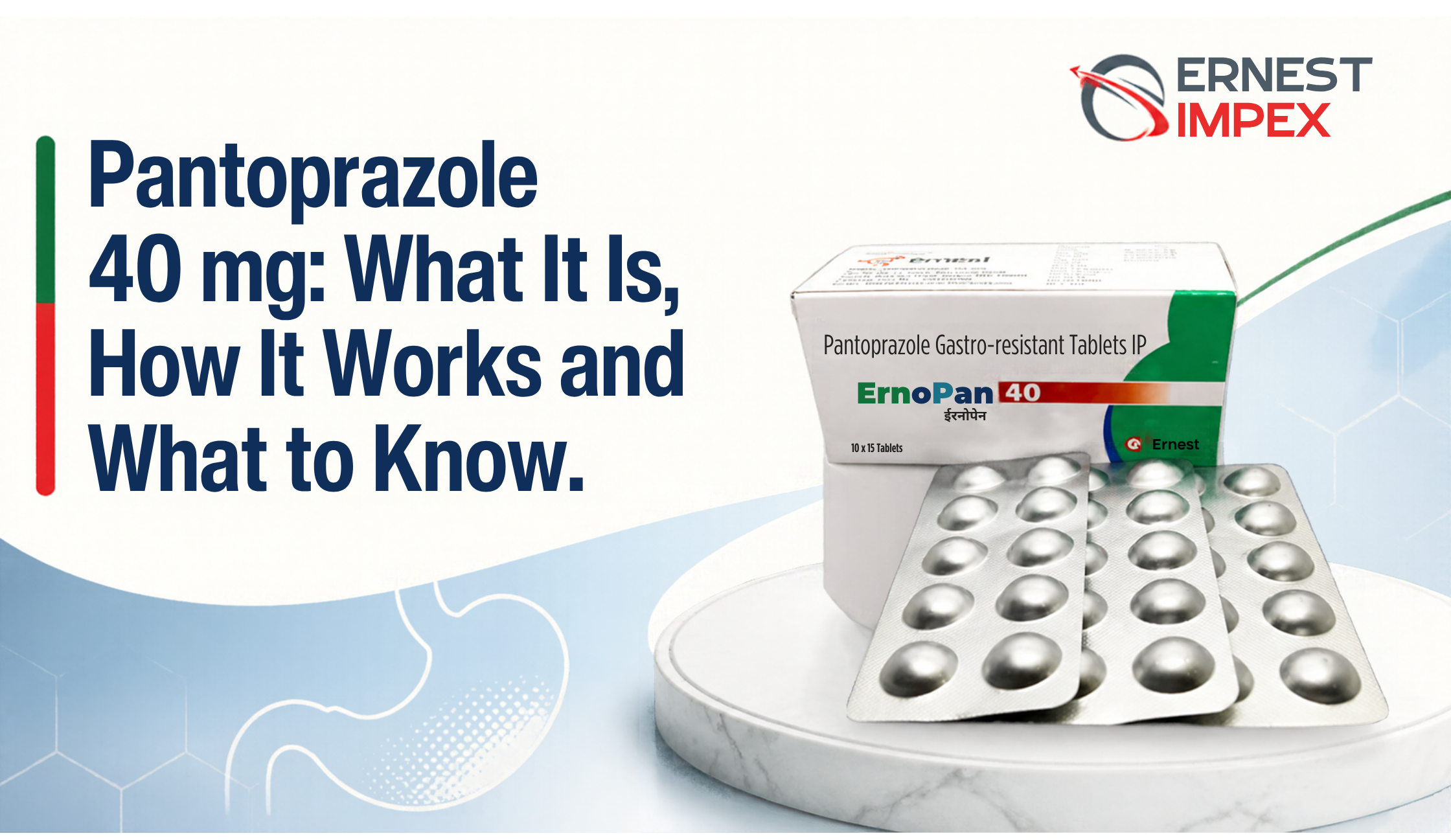
Pantoprazole 40 mg: What It Is, How It Works and What to Know
Published by Ernest Impex LLP
Pantoprazole 40 mg is a prescription-strength form of a medicine that reduces the amount of acid your stomach makes. In the UK, the NHS says pantoprazole is prescribed for conditions such as acid reflux and stomach ulcers, while lower-strength 20 mg tablets can be bought from pharmacies for heartburn or acid reflux in adults [S1]. This article explains what the 40 mg strength means and what to discuss with a healthcare professional. It is general information, not personal medical advice.
What is pantoprazole and how does it work?
Pantoprazole belongs to a group called proton pump inhibitors (PPIs). The "pumps" in the name are tiny structures in the lining of the stomach that produce acid. PPIs reduce this acid production, which lets irritated or damaged tissue in the gullet or stomach settle [S1, S3]. Pantoprazole is one of several PPIs, and NHS information says they work in a broadly similar way [S3].
What is pantoprazole 40 mg used for?
General information about pantoprazole
The NHS says pantoprazole is used for heartburn, acid reflux and gastro-oesophageal reflux disease (GORD), and to prevent and treat stomach ulcers. It is sometimes used for Zollinger-Ellison syndrome, a rare condition caused by a tumour in the pancreas or gut [S1].
Product-specific uses
The exact uses depend on the specific product's Summary of Product Characteristics (SmPC) and leaflet, and they differ between UK products. Some 40 mg tablet SmPCs list reflux oesophagitis, gastric and duodenal ulcer, and eradication of Helicobacter pylori alongside antibiotics [S5]. Others list a shorter set of indications [S4]. UK 40 mg injection SmPCs describe use in adults for reflux oesophagitis, gastric and duodenal ulcer, and Zollinger-Ellison syndrome and similar conditions [S9]. Always check the leaflet for the pack you have been given.
What does "40 mg" mean on the label?
The number shows how much pantoprazole the product contains:
- Tablets: each tablet contains 40 mg of pantoprazole, supplied as pantoprazole sodium sesquihydrate [S4].
- Injection: each vial contains 40 mg of pantoprazole as a powder [S9]. The figure describes the amount in the vial, not the strength of a ready-made liquid.
How much you take, and for how long, is decided by your prescriber. This article does not give dosing advice.
Tablets and injection compared
Gastro-resistant tablet | Powder for injection | |
|---|---|---|
How it is given | Swallowed by mouth [S6] | Into a vein, by a healthcare professional [S8] |
Typical setting | Usually at home | Clinical or hospital settings |
Age information in UK SmPCs | Some list adults and adolescents aged 12 and over [S5, S6] | Adults; not recommended under 18 [S8] |
Pantoprazole gastro-resistant tablets
"Gastro-resistant" means the tablet has a coating designed to resist stomach acid so that it releases the medicine further along the digestive tract. For this reason, one UK SmPC says tablets should not be chewed or crushed and should be swallowed whole with some water before a meal [S6]. Follow the instructions in the leaflet that comes with your own pack.
Pantoprazole injection
Pantoprazole injection is a hospital-style option. UK SmPCs say intravenous use is recommended only when oral treatment is not appropriate. Data are available for intravenous use for up to 7 days, and treatment should move to oral pantoprazole as soon as that is possible [S7]. One SmPC states that it should be administered by a healthcare professional under medical supervision [S8]. This article does not cover preparation or administration, which are for trained staff.
Common side effects
Most people have no side effects. The NHS lists headaches, diarrhoea, feeling or being sick, constipation, dry mouth and tiredness as uncommon, affecting fewer than 1 in 100 people. They are usually mild. Speak to a pharmacist or doctor if they bother you or do not go away [S2]. You can report suspected side effects through the MHRA Yellow Card scheme [S2].
When to get help urgently
The NHS advises calling a doctor or NHS 111 straight away if you have [S2]:
- joint pain with a red skin rash, especially on sun-exposed skin
- worsening stomach pain, yellowing of the skin or the whites of the eyes, or dark pee
- pain when you pee, peeing less than usual, lower back pain, swollen ankles, rash or a high temperature
- severe or persistent diarrhoea
Call 999 for signs of a serious allergic reaction, such as swelling of the lips, mouth, throat or tongue, or struggling to breathe [S2].
Important interactions
Tell your pharmacist or prescriber about everything you take, including herbal remedies. The NHS says St John's wort may stop pantoprazole working properly [S3]. UK SmPCs also flag:
- some medicines that need stomach acid to be absorbed, such as certain azole antifungals and erlotinib [S7]
- HIV protease inhibitors such as atazanavir, whose use with pantoprazole is not recommended [S7]
- warfarin, where blood clotting may need monitoring [S9]
- high-dose methotrexate, where pantoprazole may sometimes need to be paused [S7]
The NHS says pantoprazole can be taken with an antacid such as Gaviscon, and with painkillers such as paracetamol or ibuprofen [S3].
Longer-term use
The NHS says PPIs are best taken for the shortest time needed [S3]. After more than 3 months, blood magnesium levels may fall. After more than a year, the chance of bone fractures, gut infections and vitamin B12 deficiency may increase. Doctors should review long-term use regularly [S2].
UK SmPCs also warn that relief of symptoms can mask the symptoms of stomach cancer. Alarm symptoms include significant unintentional weight loss, repeated vomiting, difficulty swallowing, vomiting blood, anaemia and black stools [S5]. Tell a doctor promptly if you notice any of these.
Frequently asked questions
1. What does 40 mg mean? It is the amount of pantoprazole in one tablet or one injection vial [S4, S9]. It is not a recommendation for how much anyone should take.
2. How is pantoprazole different from an antacid? Pantoprazole reduces how much acid the stomach produces [S1]. Antacids work on acid that is already there. The two can be used together [S3].
3. How long does pantoprazole take to work? The NHS says many people feel better in 2 to 3 days, but it can take up to 4 weeks to control symptoms fully [S1].
4. Is pantoprazole safe to take long term? Long-term use needs regular review because of possible effects on magnesium, vitamin B12, bones and the gut [S2]. Do not stop or change a prescribed medicine without advice.
5. When should I speak to a pharmacist or GP? Speak to a pharmacist about mild side effects or interaction questions. Contact a GP if symptoms do not improve, if you have any alarm symptoms above [S5], or if you bought pantoprazole without a prescription and your symptoms have not improved after 2 weeks [S1]. Use NHS 111 or 999 for the urgent symptoms listed earlier [S2].
Sources (all checked 11 November 2026)
- S1: NHS, About pantoprazole: https://www.nhs.uk/medicines/pantoprazole/about-pantoprazole/
- S2: NHS, Side effects of pantoprazole: https://www.nhs.uk/medicines/pantoprazole/side-effects-of-pantoprazole/
- S3: NHS, Common questions about pantoprazole: https://www.nhs.uk/medicines/pantoprazole/common-questions-about-pantoprazole/
- S4: emc SmPC, Pantoprazole 40 mg gastro-resistant tablets (Amarox, updated 26 Feb 2026): https://www.medicines.org.uk/emc/product/14644/smpc
- S5: emc SmPC, Pantoprazole 40 mg gastro-resistant tablets: https://www.medicines.org.uk/emc/product/7090/smpc
- S6: emc SmPC, Pantoprazole 40 mg gastro-resistant tablets: https://www.medicines.org.uk/emc/product/15376/smpc
- S7: emc SmPC, Pantoprazole 40 mg powder for solution for injection (Tillomed, updated 19 Apr 2024): https://www.medicines.org.uk/emc/product/13353/smpc
- S8: emc SmPC, Pantoprazole 40 mg powder for solution for injection: https://www.medicines.org.uk/emc/product/11068/smpc
- S9: emc SmPC, Pantoprazole 40 mg powder for solution for injection/infusion (Bowmed Ibisqus, updated 8 Jun 2026): https://www.medicines.org.uk/emc/product/8762/smpc
- S10: MHRA Blue Guide: https://www.gov.uk/government/publications/blue-guide-advertising-and-promoting-medicines
- S11: GOV.UK, Advertise your medicines: https://www.gov.uk/advertise-your-medicines
- S12: Ernest Impex homepage: https://www.ernestimpex.com/
Keywords