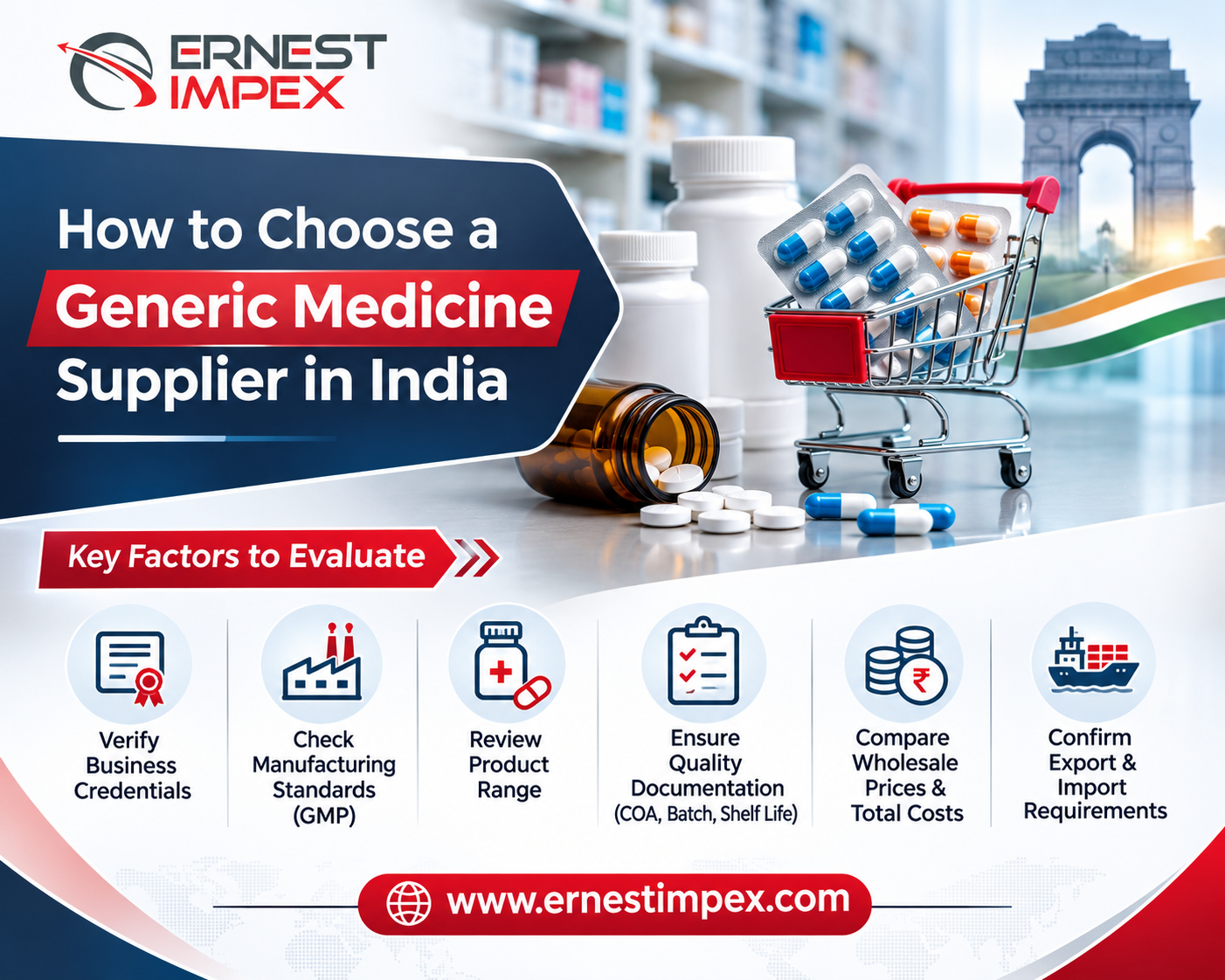
How to Choose a Generic Medicine Supplier in India
Choosing a generic medicine supplier in India requires more than finding competitive wholesale prices. Pharmaceutical importers, distributors, and institutional buyers need to consider product quality, supplier credentials, manufacturing standards, documentation, remaining shelf life, and the ability to maintain a consistent supply. India offers a wide range of pharmaceutical sourcing options. However, not every supplier will meet the technical, commercial, and regulatory requirements of every international market. This guide explains how business buyers can evaluate generic medicine suppliers and make better-informed procurement decisions.
What Is a Generic Medicine Supplier?
A generic medicine supplier is a business that provides generic pharmaceutical products to eligible wholesalers, distributors, pharmacies, hospitals, and other healthcare organizations. Generic medicines contain the same active ingredient as their corresponding reference medicines and must meet the relevant regulatory requirements for quality and performance. Their appearance, packaging, and inactive ingredients may differ. The World Health Organization provides regulatory guidance for generic pharmaceutical products, including requirements relating to interchangeability and bioequivalence. A pharmaceutical supplier may operate as a manufacturer, authorized distributor, wholesaler, or merchant exporter. Understanding this distinction is an important part of supplier evaluation.
1. Verify the Supplier's Business Credentials
Before discussing a commercial order, establish the legal identity of the supplier.
Request relevant business information, including:
Registered company name and address.
Applicable pharmaceutical wholesale or distribution licenses.
Importer Exporter Code (IEC), where applicable.
Official business contact information.
Company banking and invoicing details.
Applicable regulatory authorizations.
The details should be consistent across quotations, licenses, and commercial documents. Buyers should verify relevant credentials with the issuing authorities wherever possible. A professional-looking website alone is not sufficient evidence of regulatory compliance.
2. Understand the Difference Between Manufacturers and Suppliers
International buyers searching for generic medicine distributors in India may encounter different types of pharmaceutical businesses.
| Business Type | Primary Function |
|---|---|
| Pharmaceutical manufacturer | Produces pharmaceutical formulations |
| Medicine wholesaler | Purchases and distributes medicines in commercial quantities. |
| Pharmaceutical distributor | Supplies products through distribution networks |
| Merchant exporter | Sources products and coordinates international export requirements |
Each business model offers different advantages.
Manufacturers may be suitable for large requirements involving a specific formulation. Merchant exporters and wholesalers may be useful when a buyer requires products from several manufacturers. Ernest Impex provides pharmaceutical sourcing and export coordination for international business buyers, subject to applicable requirements.
3. Check Manufacturing Standards and Product Quality
Medicine quality should remain a central consideration when selecting a supplier. Ask for the identity of the actual manufacturer and the location where the medicine is produced. Review applicable Good Manufacturing Practice (GMP) documentation and confirm whether the manufacturing site meets the requirements of your intended market. A certificate should be evaluated for its issuing authority, validity, manufacturing location, and relevant scope. Buyers should also establish whether the medicine requires product registration, bioequivalence evidence, or additional market-specific quality documentation. The WHO model quality assurance system for procurement agencies provides a useful framework for assessing pharmaceutical procurement practices.
4. Review the Supplier's Product Range
A suitable generic medicine supplier should be evaluated against the buyer's actual product requirements rather than the size of its catalogue.
Common pharmaceutical procurement categories include:
Diabetes medicines.
Cardiovascular medicines.
Antibiotics and anti-infectives.
Gastrointestinal medicines.
Dermatological formulations.
Oncology and specialty medicines.
Hospital and institutional pharmaceutical products.
Confirm the active ingredient, strength, dosage form, manufacturer, and packaging configuration for each product. For example, two medicines may contain the same active ingredient but have different release mechanisms. An immediate-release tablet and an extended-release tablet should not automatically be treated as interchangeable. Buyers sourcing multiple pharmaceutical categories can review the wholesale medicine supply and bulk export services available through Ernest Impex.
5. Request Batch and Quality Documentation
A pharmaceutical quotation does not necessarily establish that the products meet all quality or import requirements.
Business buyers should identify the documents needed before confirming an order.
| Document or Information | Purpose |
|---|---|
| Certificate of Analysis (COA) | Records relevant batch test results |
| Manufacturing and expiry dates | Helps evaluate remaining shelf life. |
| Batch number | Supports product identification and traceability |
| GMP documentation | Provides information about applicable manufacturing standards |
| Certificate of Pharmaceutical Product (CPP/CoPP) | Supports regulatory procedures where required |
| Commercial invoice | Records commercial shipment details |
| Packing list | Identifies shipment contents and packaging |
The required documents depend on the product, procurement agreement, and destination-country regulations. Buyers should confirm documentation availability in advance rather than assuming that every document will be available after payment or dispatch.
6. Check Remaining Shelf Life Before Ordering
A medicine may have a long approved shelf life when manufactured, but the stock available for purchase may have considerably less time remaining. This difference matters when medicines must pass through international transportation, customs clearance, warehouse storage, and subsequent distribution. For example, a batch manufactured with a 36-month shelf life may have only 12 months remaining when offered to a buyer. Whether that batch is suitable depends on the importing market's requirements, expected delivery date, and inventory turnover. Agree on minimum acceptable remaining shelf life before confirming the purchase.
7. Compare Wholesale Prices and Total Procurement Costs
Many buyers searching for generic medicine wholesale distributors focus on unit prices. However, the lowest quoted price does not always represent the lowest total procurement cost.
Consider the following factors:
Medicine unit price.
Minimum order quantity.
Packaging charges.
Freight and insurance costs.
Customs duties and applicable taxes.
Documentation and inspection expenses.
Potential losses associated with short-dated stock.
Example of a Wholesale Cost Comparison
Consider two hypothetical suppliers offering the same medicine for an order of 1,000 packs.
| Cost Component | Supplier A | Supplier B |
|---|---|---|
| Medicine cost | $1,000 | $1,100 |
| Shipping and handling | $300 | $150 |
| Total initial cost | $1,300 | $1,250 |
Although Supplier A offers a lower medicine price, Supplier B has a lower combined cost in this example. Actual landed costs will depend on destination charges, trade terms, and regulatory requirements. The figures above are illustrative and do not represent actual market quotations.
8. Confirm Storage and Transportation Arrangements
Appropriate pharmaceutical storage is important throughout the distribution process. Some medicines require protection from moisture, light, or excessive heat. Others require temperature-controlled transportation according to their approved storage conditions. Before placing an order, ask the supplier how the products will be stored, packed, and transported. For temperature-sensitive products, establish the required monitoring and procedures for handling temperature deviations. The WHO Good Storage and Distribution Practices for Medical Products explains the importance of maintaining product quality throughout storage and distribution. Shipping arrangements should reflect the specific medicine's requirements rather than applying the same packaging method to every product.
9. Evaluate Export Documentation and Import Eligibility
A medicine available in India is not automatically authorized for import or distribution in another country.
International buyers should check:
Product registration or marketing authorization.
Import licenses or permits.
Local packaging and labeling requirements.
Manufacturer and product approval requirements.
Applicable import and distribution restrictions.
The exporter and importer should agree on their respective responsibilities before arranging a shipment. Businesses exploring international sourcing can review Ernest Impex's B2B pharmaceutical export services for further information about its procurement and export support.
10. Assess Communication and Long-Term Supply Capability
A supplier's performance becomes particularly important when a distributor requires recurring pharmaceutical orders. Evaluate how clearly the supplier communicates product availability, documentation limitations, lead times, and commercial terms. Ask how stock shortages, order discrepancies, quality complaints, and product recalls are handled. A supplier that offers transparent information about these situations can help buyers plan their inventory and procurement activities more effectively. For recurring orders, maintain records of delivery performance, documentation accuracy, and previous quality concerns.
Generic Medicine Supplier Verification Checklist
Before approving a new pharmaceutical supplier, review the following points:
Verify the supplier's legal business identity.
Confirm applicable licenses and authorizations.
Establish the actual manufacturer's identity.
Review relevant manufacturing and quality documents.
Confirm product specifications and packaging.
Confirm batch details and remaining shelf life.
Compare total procurement costs.
Review storage and transportation arrangements.
Confirm destination-market import eligibility.
Establish written commercial and quality complaint procedures.
This checklist can also be used when comparing existing suppliers or reviewing long-term distribution partnerships.
Common Mistakes When Choosing a Generic Medicine Supplier
One common mistake is selecting a supplier based entirely on the lowest wholesale price. Other procurement mistakes include accepting unverified certificates, overlooking remaining shelf life, and assuming that products with similar compositions have identical regulatory status. Buyers should also avoid relying on verbal promises when confirming important order requirements. A clearly documented procurement agreement can reduce misunderstandings about product specifications, documentation, payment terms, and delivery responsibilities.
Frequently Asked Questions
1. How do I identify a reliable generic medicine supplier in India?
Evaluate the supplier's legal credentials, manufacturer relationships, product documentation, supply history, and ability to meet the importing market's requirements.
2. What is the difference between a generic medicine manufacturer and a supplier?
A manufacturer produces medicines, while a supplier sources or distributes pharmaceutical products. Some companies perform both functions.
3. What documents should generic medicine wholesale distributors provide?
Relevant documents and information may include batch details, commercial invoices, packing lists, applicable quality certificates and product-specific regulatory documentation.
4. Can generic medicines from India be exported to every country?
No. Export and import eligibility depend on the medicine, manufacturer, buyer authorization, and regulations of the destination country.
5. How can pharmaceutical buyers compare wholesale medicine prices?
Compare equivalent product specifications and calculate total procurement costs, including shipping, handling, applicable taxes, and documentation expenses.
6. Is the lowest-priced pharmaceutical supplier always the best option?
No. Product quality, traceability, remaining shelf life, compliance, and supply consistency are also important purchasing considerations.
7. Can international buyers request medicines from a specific manufacturer?
Yes. Buyers can specify a preferred manufacturer, subject to availability, applicable permissions, and product documentation requirements. Additional information is available in the frequently asked questions section of Ernest Impex.
Conclusion
Choosing a generic medicine supplier in India is an important decision for pharmaceutical importers, distributors, and wholesale buyers. A suitable sourcing partner should be evaluated through verifiable business credentials, clearly identified manufacturers, appropriate product documentation, transparent commercial terms and responsible distribution practices. By focusing on quality, compliance and long-term supply performance rather than price alone, pharmaceutical buyers can develop a more organised and dependable procurement process. All pharmaceutical procurement and distribution activities must comply with applicable laws, product authorisations and destination-market regulatory requirements.
Keywords