Medicine Expiry Date vs Shelf Life: What Buyers Should Know
Have you ever looked at a medicine box and wondered whether the expiry date tells you how long the medicine lasts or simply when it should no longer be used? It is a common question, especially when the packaging shows a manufacturing date, expiry month, and batch number together. For pharmaceutical buyers, the difference matters even more. A medicine might have a valid expiry date but still have too little time remaining for shipping, warehousing, and distribution. Understanding the medicine's expiry date, shelf life, and remaining shelf life can help buyers make better purchasing decisions and avoid unnecessary stock losses.
What Is a Medicine's Expiry Date?
A medicine expiry date is the date up to which the manufacturer has established that the product should meet its quality specifications when stored according to its labeled conditions. The date is based on stability testing, not simply an estimate of how long a medicine might last. According to the US Food and Drug Administration (FDA), expiration dating is supported by studies that assess whether a medicine maintains its strength, quality and purity over time.
A medicine may be labelled with an expiry date such as:
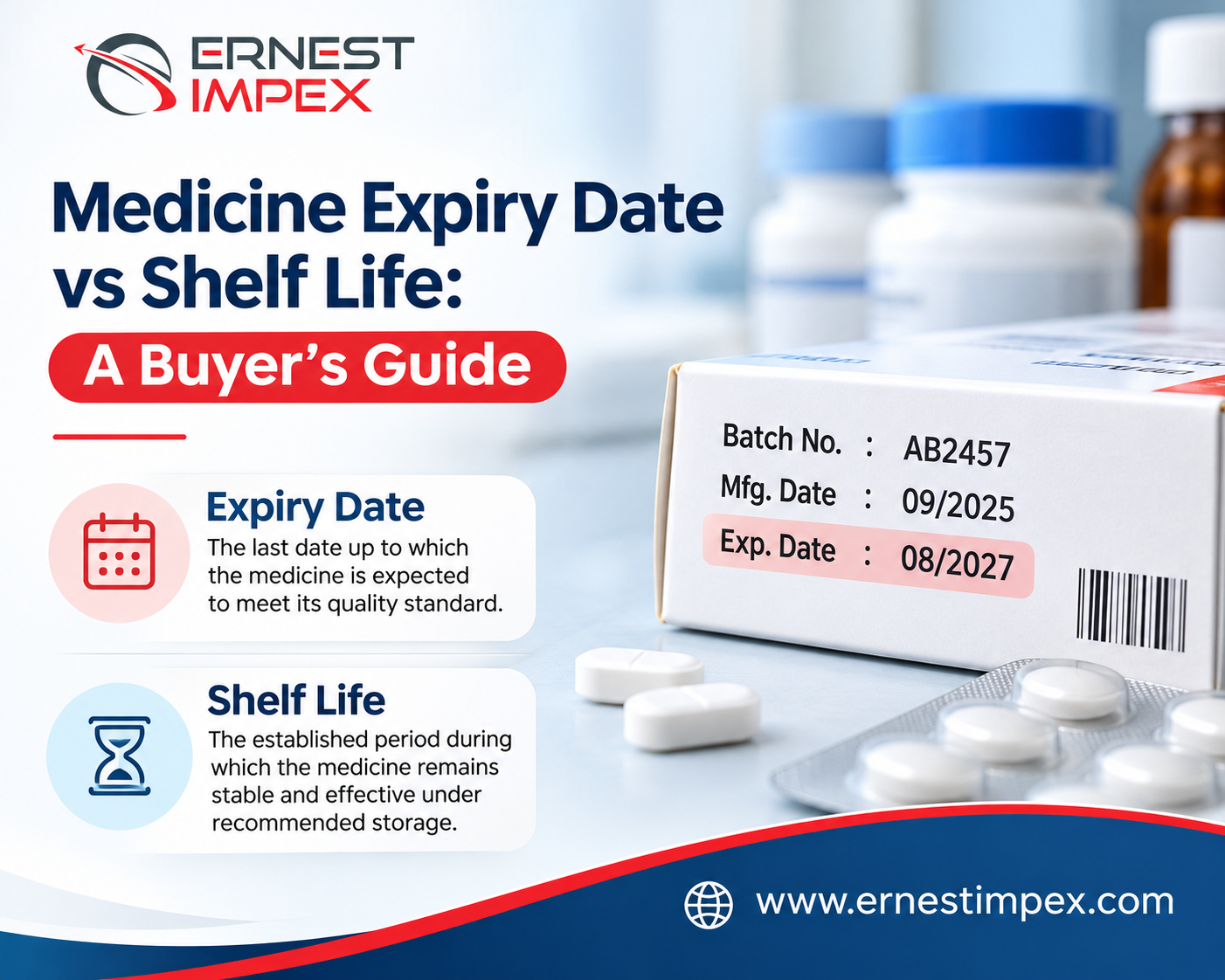
EXP: 08/2027
This indicates August 2027 as the labelled expiry month. The precise date interpretation should follow the applicable labelling convention and product information. The expiry date is not a guarantee that a product will remain suitable if it has been exposed to incorrect storage conditions.
What Is Medicine Shelf Life?
Medicine shelf life is the established period during which a pharmaceutical product is expected to remain within its required quality specifications under the recommended storage conditions. For example, a manufacturer may establish a shelf life of 24 months for a particular formulation. That period must be supported by appropriate stability data. Shelf life can differ between medicines because of their ingredients, dosage forms, packaging and storage requirements. The FDA's guidance on expiration dating and stability testing explains why formulation and packaging characteristics can affect product stability.
Is Shelf Life the Same for Every Medicine?
No. A tablet, injection, oral suspension, and biological medicine can have very different stability characteristics. Even two products containing the same active ingredient can have different shelf lives if their formulations, packaging, or approved storage conditions differ. Buyers should rely on the specific manufacturer's product and batch information.
Medicine Expiry Date vs Shelf Life: Key Differences
Although the terms are related, they describe different aspects of pharmaceutical stability.
| Feature | Medicine Expiry Date | Medicine Shelf Life |
|---|---|---|
| Meaning | The labelled date through which product quality is supported | The established period of product stability |
| Display | Usually printed on the medicine packaging | May be stated in product specifications or regulatory information |
| Example | EXP: 08/2027 | 24 months |
| Determination | Based on approved or applicable dating procedures and stability data | Established through stability studies |
| Buyer relevance | Helps identify when a batch reaches its expiry | Helps assess product planning and expected usable life |
For a pharmaceutical buyer, another important concept is the remaining shelf life. This refers to the time left before a particular batch reaches its expiry date.
How to Read the Expiry Date on Medicine Packaging
Medicine packaging may show several dates and identification codes.
A typical label might include:
| Label | Example | Meaning |
|---|---|---|
| MFG | 09/2025 | Manufacturing month and year |
| EXP | 08/2027 | Expiry month and year |
| Batch No. | AB2457 | Manufacturer's batch identification |
| Storage | Store as labelled | Required storage conditions |
These examples are illustrative, not real product details.
When checking a medicine expiry date, first identify the field marked EXP, Expiry, or Expiration. Do not confuse the manufacturing date with the expiry date. The FDA's explanation of over-the-counter medicine labels also describes the role of expiration dates and lot or batch codes on medicine packaging.
Medicine Expiry Date Format
Common formats include:
MM/YYYY
MM/YY
DD/MM/YYYY
YYYY-MM-DD
The format can vary by manufacturer and market. If a date could be interpreted in more than one way, buyers should confirm the manufacturer's intended format rather than guessing.
Does Medicine Expire at the Start or End of the Month?
This is one of the practical questions people search for when a medicine displays only a month and year. For many US pharmaceutical products, a month-and-year expiry is interpreted through the last day of the stated month. However, buyers should verify the applicable product and labeling requirements, particularly for internationally sourced medicines. If a medicine has an unclear date format or conflicting information, ask the manufacturer or authorized supplier for clarification. For pharmaceutical procurement, a written confirmation is preferable to making assumptions from the printed date.
Can you calculate the expiry date of a medicine from its manufacturing date?
A manufacturing date tells you when a product was made. It does not, by itself, establish the expiry date. Consider a medicine manufactured in January 2026. If its manufacturer has established and assigned a 24-month shelf life using the applicable dating procedure, the expiry date can be determined from the approved batch-dating information. However, the buyer cannot assume every medicine manufactured in January 2026 expires exactly 24 months later. Some products have shorter or longer shelf lives. Certain formulations also have special dating rules. The correct expiry date should come from the manufacturer's batch records and approved product information.
Why Online Expiry Date Calculators Can Be Misleading
An online calculator may ask for a manufacturing date and a shelf-life period. The calculation is only meaningful when the correct product-specific shelf life and dating convention are already known. A calculator cannot establish a medicine's actual stability or independently verify the manufacturer's expiry date.
Can You Check a Medicine's Expiry Date Using Its Batch Number?
A batch number identifies a particular manufacturing lot. It is useful for traceability, quality investigations, product recalls, and manufacturer verification. However, a batch number is not a universal expiry-date code. Different manufacturers use different numbering systems, and the digits may not directly represent the manufacturing or expiry date.
How to Verify a Batch Expiry Date
For a check of a medicine's expiry date, buyers can:
Read the expiry date printed on the original pack.
Compare the batch number across the carton, blister or vial, where applicable.
Review the available batch-related documents.
Contact the manufacturer or authorised supplier if information is missing or inconsistent.
Hold the affected stock for review if the expiry information appears altered or unreliable.
There is no single public website that can verify the expiry date of every medicine using its batch number. A batch number alone should not be used to calculate an expiry date without access to the manufacturer's records.
What If the Expiry Date Is Erased or Unreadable?
An unreadable expiry date should not be treated as a minor packaging issue. If the date is missing, damaged, or appears to have been changed, buyers should avoid guessing. The affected product should be held for verification under the organization's quality procedures. The manufacturer or authorized supplier may be able to confirm the batch details through legitimate records. For commercial buyers, the relevant quality team should decide whether the product can be accepted or distributed.
How Storage Conditions Affect Medicine Shelf Life
A medicine's labelled expiry date assumes that the product has been stored under the required conditions. Excessive heat, freezing, humidity, or light exposure may affect stability, depending on the formulation. For example, a medicine requiring refrigeration may need special handling during international transportation. Even if the expiry date is several months away, unsuitable storage could raise concerns about product quality. Ernest Impex's guide to pharmaceutical export processes and documents explains why you should review product specifications and shipping conditions before international dispatch. The FDA also explains that products stored outside their labelled conditions may degrade before their printed expiry dates.
Why Remaining Shelf Life Matters for Pharmaceutical Buyers
For importers and wholesalers, the expiry date is only one part of the purchasing decision. The remaining shelf life determines how much time is available for transportation, customs clearance, storage, and distribution.
Consider two hypothetical batches of the same medicine.
| Batch | Expiry Date | Remaining Shelf Life on 20 Nov 2026 |
|---|---|---|
| Batch A | November 2027 | Approximately 12 months |
| Batch B | March 2027 | Approximately 4 months |
Both batches may be within their labelled expiry periods, but they offer different distribution timelines. A buyer expecting several months of warehousing may prefer the batch with longer remaining shelf life. However, the minimum acceptable remaining shelf life depends on the buyer's procurement requirements and applicable destination-country rules.
What Buyers Should Confirm Before Ordering
Important checks include:
Exact product and dosage form
Manufacturer and batch details
Printed expiry date
Required remaining shelf life
Applicable storage conditions
Available quality documentation
Expected shipping and customs timelines
Destination-country import requirements
For international transactions, buyers can review Ernest Impex's pharmaceutical exporter information for additional sourcing context.
Can Medicines Be Used After Their Expiry Date?
An expired medicine should not be assumed safe or effective. After its labelled expiry date, the manufacturer no longer provides the same assurance of quality under the established dating period. Some products may lose strength or undergo other changes over time. The FDA explains these risks in its expiration dates questions and answers. Certain products may have their expiry dates extended through limited, officially managed programs that use additional scientific evidence. These programs do not mean that consumers or wholesalers can independently extend expiry dates. For ordinary use and commercial distribution, follow the applicable product label, regulatory requirements, and qualified professional guidance.
A Simple Expiry Date Checklist for Medicine Buyers
Before accepting a pharmaceutical shipment, check the following:
| Check | Why It Matters |
|---|---|
| Expiry date clearly printed | Avoids uncertainty about the product's dating |
| Batch number identifiable | Supports traceability |
| Remaining shelf life acceptable | Allows time for distribution |
| Storage conditions reviewed | Helps protect product quality |
| Packaging intact | Identifies possible handling or tampering concerns |
| Batch documents consistent | Supports quality verification |
| Destination requirements checked | Helps avoid import or distribution problems |
Frequently Asked Questions
1. What is the difference between the medicine expiry date and the shelf life?
Shelf life is the established period during which a medicine is expected to meet its quality specifications under recommended storage conditions. The expiry date is the labelled date associated with that period for a specific product or batch.
2. How can I check a medicine's expiry date?
Look for the EXP or expiration field on the original packaging. If it is unclear, confirm the information through the manufacturer or authorized supplier.
3. Can I determine a medicine's expiry date from its batch number?
Not reliably without the manufacturer's coding system or records. Batch numbers are primarily used for product identification and traceability.
4. Does a medicine expire at the beginning or end of the printed month?
For many US products, a month-and-year expiry refers to the end of that month. Check the applicable labelling convention and manufacturer information if there is uncertainty.
5. Can I calculate the expiry date from the manufacturing date?
Only if the correct, manufacturer-established shelf life and applicable batch-dating rules are known. The manufacturing date alone is insufficient.
6. Is there an online medicine expiry date checker?
Some manufacturers may provide product-specific verification services, but there is no universal public checker for every medicine and batch.
7. Can medicine be used after the expiration date?
Expired medicine should not be assumed safe or effective. Follow the product label and obtain advice from a qualified healthcare professional when needed.
8. Why do wholesalers check remaining shelf life?
Remaining shelf life helps wholesalers plan transportation, customs clearance, warehousing, and distribution before the product reaches its expiry date.
Conclusion
Understanding the medicine expiry date is useful for anyone handling pharmaceutical products, but it is particularly important for importers and wholesalers. The expiry date tells buyers when a specific product reaches its established dating limit. Shelf life describes the period supported by stability testing, while remaining shelf life shows how much time is left for a particular batch. Checking dates, batch information, storage conditions and supporting documents before accepting an order helps buyers make informed procurement decisions.
Keywords