Export of Pharmaceuticals from India: Process and Documents
The export of pharmaceuticals from India involves product sourcing, regulatory checks, quality documentation, customs clearance, and international transportation. For importers and pharmaceutical distributors, understanding these steps before placing an order can help prevent delays and documentation problems. India supplies a wide range of finished pharmaceutical products to international markets. However, the ability to export a medicine from India does not automatically mean it can be imported or marketed in another country. This guide explains the practical pharmaceutical export process, the documents buyers may need, and the checks they must complete before shipment.
What Does the Export of Pharmaceuticals from India Involve?
Pharmaceutical exports involve moving medicines from an eligible Indian exporter to an overseas buyer in accordance with applicable trade and drug regulations. A typical transaction may involve a manufacturer, a merchant exporter, a freight provider, a customs representative, and a licensed importer. Each party has different responsibilities. The manufacturer is responsible for activities under its manufacturing authorization, while the exporter coordinates the commercial export transaction. The overseas importer must meet the requirements of the destination country. International buyers can also review Ernest Impex's pharmaceutical exporter and global B2B supply overview for general information about medicine sourcing from India.
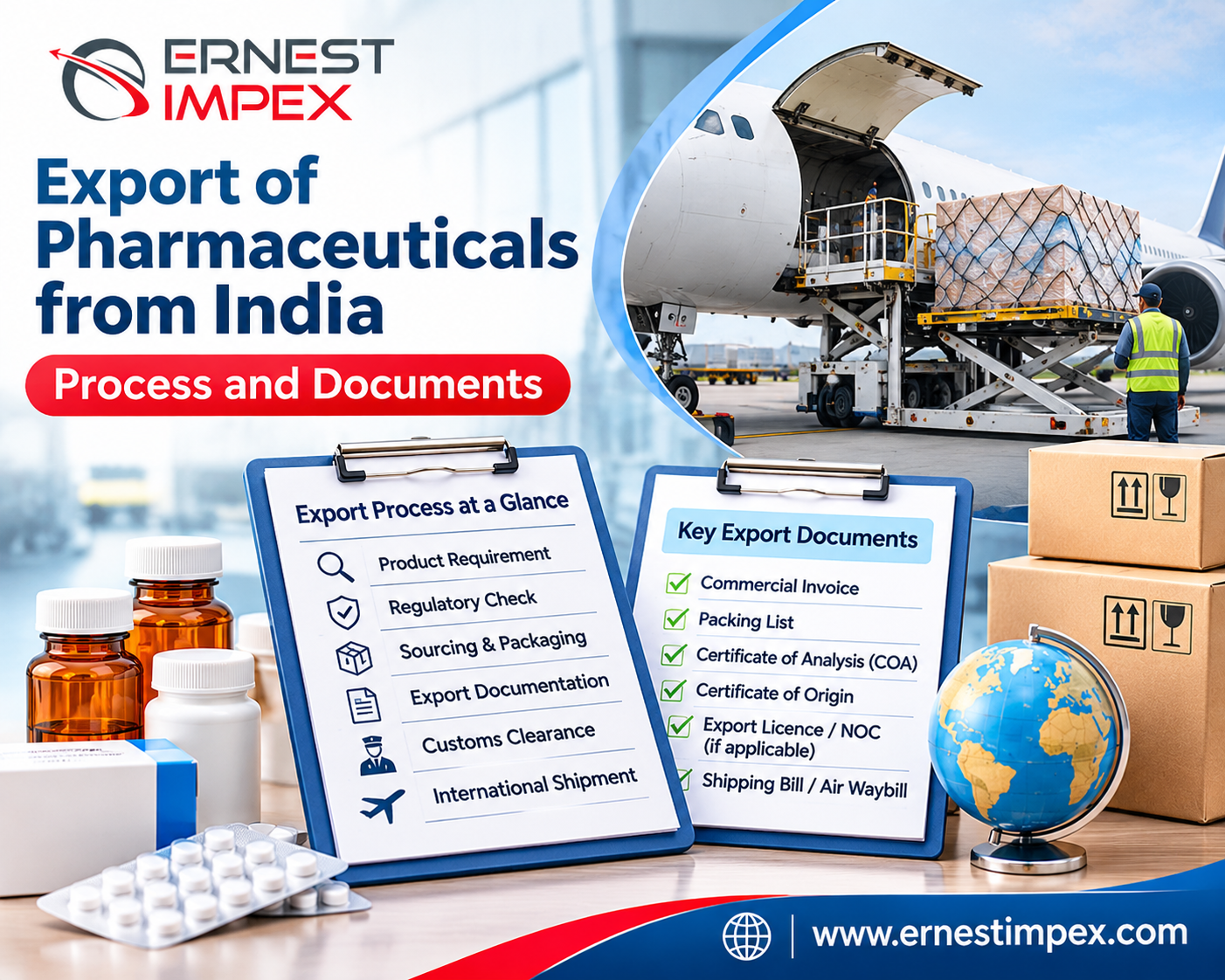
Step-by-Step Pharmaceutical Export Process from India
1. Confirm the Medicine Requirement
The process begins when an international buyer submits a product inquiry.
The inquiry should include:
Generic or brand name
Strength and dosage form
Pack size and required quantity
Preferred manufacturer, if any
Destination country
Required remaining shelf life
Any special documentation or labelling requirements
Clear specifications are particularly important when different formulations or pack sizes are available under similar product names.
2. Verify the Buyer and Import Eligibility
Before confirming an order, both parties should check whether the proposed transaction is permitted. The importer may need a pharmaceutical import license, product registration, marketing authorization, or other approvals, depending on local law. The buyer should also confirm whether the product is subject to prescription, controlled-drug, or other special restrictions. For example, a medicine registered for sale in India may not be authorized for commercial distribution in the buyer's country.
3. Check Product Availability and Source
The exporter reviews the requested medicine against available supply channels. Important checks include the manufacturer, strength, dosage form, pack configuration, batch information, expiry date and storage conditions. Buyers handling wholesale orders should communicate their documentation requirements at this stage, rather than waiting until the products are ready for dispatch. Ernest Impex provides information about wholesale medicine supply and bulk pharmaceutical exports for eligible international procurement inquiries.
4. Prepare the Commercial Quotation
After reviewing product availability and relevant requirements, the exporter can prepare a quotation. The quotation should clearly identify the product, quantity, price, currency, delivery terms, validity period, and any separately charged services. International trade terms should be agreed upon before payment and dispatch. They help establish responsibility for transportation costs, risk, and other commercial obligations. They do not replace pharmaceutical regulatory requirements.
5. Review Licenses and Regulatory Permissions
The export of pharmaceuticals from India may involve general trade requirements and additional product-specific drug regulations. An Importer Exporter Code (IEC) is generally required for Indian import and export activities, subject to specified exemptions. The Directorate General of Foreign Trade provides official guidance on IEC and foreign trade procedures. Certain new, unapproved, or otherwise specially regulated drugs may require an export-related No Objection Certificate or other permission. The CDSCO export NOC notice explains the online process for specified categories through the SUGAM system. Not every medicine requires the same export NOC. The applicable procedure must be checked for the specific product and activity.
6. Prepare Export Documentation
The exporter and relevant service providers prepare the documents needed for the transaction. The exact document set depends on the goods, destination, shipping mode, and regulatory requirements. Commercial documents should accurately reflect the products being shipped. Names, quantities, values, and package details should be consistent across the invoice, packing list, and applicable declarations.
7. Arrange Suitable Packaging and Transportation
Pharmaceutical packaging and transport arrangements should reflect the product's approved storage conditions. For example, a medicine requiring refrigerated storage may need a qualified temperature-controlled shipping arrangement. A standard courier service may not be suitable. The packaging plan should consider transit duration, temperature exposure, product protection, labelling, and the carrier's acceptance requirements.
8. Complete Customs Clearance and Dispatch
The export customs process may include electronic shipping bill filing and the submission of supporting information. India's ICEGATE portal provides information about electronic customs services and shipping bill procedures. Following the required clearances and acceptance by the carrier, the shipment can proceed to the destination. The exporter may then provide the buyer with the applicable transport document and tracking details.
Documents Required for Pharmaceutical Exports from India
International buyers often ask which documents they need to export medicine from India. There is no universal checklist that applies to every pharmaceutical shipment. The following documents are commonly relevant, although their applicability varies.
| Document | Purpose |
|---|---|
| Commercial Invoice | Records products, buyer and seller details, values and commercial terms |
| Packing List | Identifies package contents, quantities and packing information |
| Shipping Bill | Supports the Indian export customs declaration |
| Air Waybill or Bill of Lading | Records shipment and carriage information |
| Importer Exporter Code | Identifies the Indian importing or exporting entity |
| Certificate of Analysis | Provides relevant batch-specific testing information |
| Certificate of Origin | Establishes origin information where required |
| Product Registration or Import Permit | Supports import eligibility in the destination market |
| Export NOC or Special Permission | Applies to specified products or activities |
| Insurance Certificate | Records cargo insurance where applicable |
Buyers should agree on the required documents before confirming an order.
Pharmaceutical Export License and Regulatory Requirements
Businesses researching a drug export license in India should distinguish between general trade registration and pharmaceutical regulatory permissions. An IEC supports import and export activities but does not replace licenses required under applicable drug laws. Depending on the business model and medicine category, manufacturing, sale, distribution, or product-specific permissions may also be relevant. The CDSCO guidance documents provide regulatory information for selected pharmaceutical activities. For certain unapproved or new drugs manufactured solely for export, specific procedures and supporting documents apply. Exporters should review the latest applicable rules before proceeding, especially when the product falls into a specially regulated category.
Why Are Batch Details and Quality Documents Important?
Batch details help buyers identify the particular manufacturing lot supplied.
For pharmaceutical procurement, relevant information may include:
Batch number
Manufacturing date, where provided
Expiry date
Manufacturer details
Product specifications
Applicable quality documents
A Certificate of Analysis (COA) may provide test results for a specific batch or material against defined specifications. However, a COA is not a substitute for a manufacturing license, import authorization, or marketing approval. Buyers should verify which quality documents their regulator, procurement department or tender requires.
Importing Country Requirements for Pharmaceutical Buyers
India pharmaceutical export transactions must satisfy both applicable Indian requirements and the importing country's laws.
Depending on the market, buyers may need to confirm:
Whether the medicine is registered or otherwise permitted
Whether the manufacturer is acceptable to the regulator
Whether the importer holds the necessary license
Whether local-language labeling is required
Whether the pack size and product information are compliant
Whether special permits apply
Whether minimum remaining shelf-life rules exist
These requirements can differ considerably between countries.
Importers should obtain confirmation from their local medicines authority or qualified regulatory adviser before purchasing regulated products.
Common Mistakes During Medicine Export from India
Missing or Incomplete Product Specifications
An inquiry that omits strength, dosage form, or manufacturer preference can lead to incorrect sourcing or quotation details.
Inconsistent Commercial Documents
Differences between the invoice, packing list, and shipping information may cause additional checks or delays.
Assuming All Products Have the Same Export Permissions
Different medicines may fall under different regulatory categories. A document applicable to one product may not be required—or sufficient—for another.
Checking Import Eligibility Too Late
The buyer should verify product registration and import permissions before an order is finalized.
Overlooking Storage Requirements
Temperature-sensitive products require suitable handling arrangements. Inappropriate transport can create quality risks.
Requesting Certificates After Dispatch
Some supporting documents may depend on the manufacturer, batch, or regulatory procedure. Their availability should be confirmed early.
Pharmaceutical Export Checklist for International Buyers
Before placing an order, procurement teams can review the following points.
| Check | Buyer Question |
|---|---|
| Product specification | Is the exact medicine and formulation confirmed? |
| Import eligibility | Can the medicine legally enter the destination country? |
| Manufacturer | Is the proposed manufacturer acceptable? |
| Batch information | Is the remaining shelf life suitable? |
| Documentation | Are the required certificates available? |
| Commercial terms | Are prices and delivery responsibilities clear? |
| Shipping | Is the transport method suitable for the medicine? |
| Customs | Are the product and shipment details consistent? |
Using a checklist can help buyers identify unresolved issues before dispatch.
How Merchant Exporters Support Pharmaceutical Procurement
A merchant exporter may coordinate product inquiries, supplier communication, commercial quotations, documentation, and international shipment arrangements. This can be useful when an overseas distributor needs to review several medicines or compare available sourcing options. However, working with a merchant exporter does not remove the buyer's responsibility to comply with local import and distribution laws. Ernest Impex's frequently asked questions provide additional information about inquiries, quotations, documentation, and shipping arrangements.
Frequently Asked Questions
1. What is the process for exporting pharmaceuticals from India?
The process generally includes product enquiry, buyer verification, sourcing, regulatory review, commercial documentation, suitable packaging, customs clearance and international dispatch.
2. What documents are required to export medicine from India?
Common documents include a commercial invoice, packing list, applicable shipping bill and transport document. Quality certificates, import permits and special regulatory permissions may also be required.
3. Is an IEC necessary for pharmaceutical exports?
An IEC is generally required for import and export activities in India, subject to specified exemptions. Additional pharmaceutical licences or permissions may also apply.
4. Does every medicine require a CDSCO export NOC?
No. Export NOC requirements apply to specified products and activities. The relevant rules must be checked for each medicine.
5. Can a merchant exporter export medicines manufactured by another company?
An appropriately authorised merchant exporter may source and export eligible pharmaceutical products through lawful supply channels, subject to applicable requirements.
6. Is a Certificate of Analysis mandatory for every shipment?
Not universally. COA requirements depend on the product, destination regulations, procurement conditions and other applicable requirements.
7. Can medicines manufactured in India be imported into any country?
No. Import eligibility depends on the destination country's laws, product authorisation, importer permissions and any applicable restrictions.
8. Why should buyers verify export documents before shipment?
Early verification helps identify missing permissions, inconsistent product details, unavailable certificates and unsuitable transport arrangements before dispatch.
Conclusion
The export of pharmaceuticals from India requires careful coordination between suppliers, exporters, importers, logistics providers, and regulatory authorities. For international pharmaceutical buyers, the most important steps are confirming the exact product, verifying import eligibility, reviewing required documents, and arranging suitable transportation. A clear process and complete, accurate records can help reduce avoidable problems during international pharmaceutical procurement.
Keywords