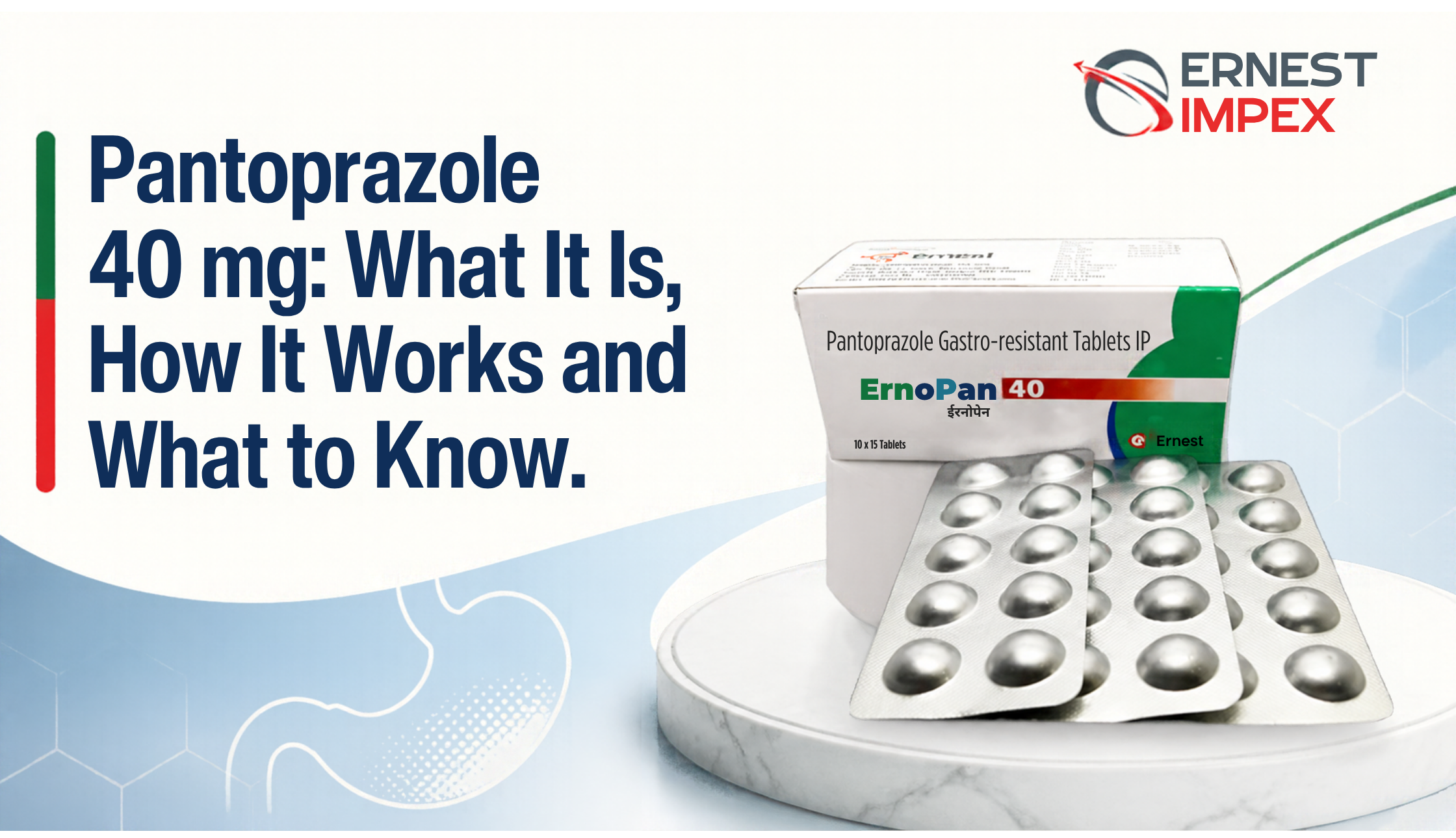
Pantoprazole Sodium 40 mg Tablets: What They Are and How to Read the Label
Published by Ernest Impex LLP.
Pantoprazole sodium 40 mg tablets are a prescription medicine that lowers the amount of acid your stomach makes. On the US label, they are listed for acid-related damage to the esophagus caused by gastroesophageal reflux disease (GERD), and for conditions where the stomach makes too much acid [S1, S2]. This article explains those uses, what "40 mg" and "delayed-release" mean on a tablet label, and key safety points. It is general education, not personal medical advice.
How does pantoprazole work?
Pantoprazole is a proton pump inhibitor, or PPI. Your stomach lining contains tiny "pumps" that produce acid. PPIs switch off many of them, so less acid is made. The label describes this as blocking an enzyme system at the surface of acid-producing stomach cells [S1].
What uses does the US label list?
The label for generic pantoprazole delayed-release tablets (revised 12/2025) lists three uses [S1]:
- Short-term treatment of erosive esophagitis with GERD: GERD means stomach acid keeps flowing back into the esophagus, the tube from throat to stomach. Erosive esophagitis means that acid has inflamed or damaged the esophagus lining. This use covers adults and children aged 5 and older, for up to 8 weeks.
- Maintaining healing of erosive esophagitis: for adults with GERD, to help keep heartburn from returning. Controlled studies did not go beyond 12 months.
- Pathological hypersecretory conditions: conditions in which the stomach makes far too much acid, including the rare Zollinger-Ellison syndrome.
MedlinePlus also notes that pantoprazole may be used for stomach ulcers, and that a doctor should discuss the risks of that use [S2]. How much to take and for how long is a decision for the prescriber.
What does "40 mg" mean on the label?
On the verified US label, a 40 mg tablet contains 40 mg of pantoprazole, which is equivalent to 45.1 mg of pantoprazole sodium [S1]. The sodium is the salt form of the medicine. It is not a separate 40 mg of sodium.
Tablets from different manufacturers can look different. Their labels list different colors, shapes and imprint codes [S1, S3]. A pharmacist can confirm that the tablets in your bottle match your prescription.
What does "delayed-release" mean?
A delayed-release tablet has a coating that keeps it intact in the stomach. The label says absorption begins only after the tablet leaves the stomach [S1]. MedlinePlus describes the same idea: the medicine is released in the intestine so stomach acid does not break it down [S2].
That is why the label says to swallow the tablet whole, with or without food, and not to split, chew or crush it [S1, S2].
How is pantoprazole different from an antacid?
An antacid neutralizes acid that is already in your stomach [S4]. Pantoprazole instead reduces how much acid your stomach produces [S1, S2]. The two are not interchangeable. The label says taking antacids at the same time does not affect pantoprazole absorption [S1]. A pharmacist can help if you are unsure what to use for which symptoms.
Common side effects
In US trials of adults with GERD, the most frequent side effects (more than 2% of patients) were headache, diarrhea, nausea, abdominal pain, vomiting, gas, dizziness and joint pain [S1]. Tell your doctor if side effects are severe or do not go away [S2].
When to call a doctor or get emergency help
MedlinePlus says to call your doctor right away, or get emergency help, for any of these [S2]:
- blistering, peeling or bleeding skin, or sores on the lips, nose, mouth or genitals
- swelling of the face, lips, mouth, throat or tongue, or trouble breathing or swallowing
- severe diarrhea with watery stools that does not go away
- new or worsening joint pain, or a rash on the cheeks or arms that gets worse in sunlight
- changes in how much you urinate, or blood in your urine
- an irregular or pounding heartbeat, muscle spasms, shaking or seizures
You can report side effects to FDA MedWatch at www.fda.gov/medwatch or 1-800-FDA-1088 [S1]. If someone may have taken too much, call Poison Control at 1-800-222-1222 [S2].
Important warnings and interactions
The label says pantoprazole must not be used by people allergic to it or to related "substituted benzimidazole" medicines. It also must not be used with rilpivirine-containing HIV medicines [S1].
Tell your prescriber and pharmacist about everything you take. The label flags some other medicines for special attention [S1, S2]:
- warfarin, where blood-clotting tests may need monitoring
- some other HIV medicines
- high-dose methotrexate
- medicines that need stomach acid to be absorbed well, such as iron salts, erlotinib, ketoconazole and itraconazole
Longer-term use
The label advises using the lowest dose for the shortest time appropriate [S1]. It describes possible risks that grow with longer use [S1]:
- bone fractures, mainly with long-term or multiple daily doses
- stomach growths called fundic gland polyps, especially beyond one year
- low magnesium after about three months or more
- vitamin B12 deficiency after several years of daily use
- diarrhea caused by a Clostridium difficile infection
Feeling better does not rule out a more serious stomach problem. The label tells patients to return to their healthcare provider if symptoms respond poorly or come back early [S1]. Do not stop taking pantoprazole without talking to your doctor [S2].
Frequently asked questions
1. What if I miss a dose? The label says to take it as soon as possible. If the next dose is almost due, skip the missed one. Never take two doses at once [S1].
2. Why does my tablet look different from last time? Different manufacturers make generic tablets with different colors and imprints [S1, S3]. Ask your pharmacist to confirm the product.
3. Can I stop once I feel better? MedlinePlus says to keep taking it even when you feel well, and not to stop without talking to your doctor [S2].
4. Can I take it during pregnancy or breastfeeding? The label advises telling your prescriber if you are pregnant, plan to become pregnant or are breastfeeding. It notes that pantoprazole has been found in breast milk [S1, S2]. Your prescriber can weigh the benefits and risks.
5. Can it affect lab or drug tests? Yes. It can raise chromogranin A levels, which matter for certain tumor tests, and can cause false-positive urine tests for THC [S1]. Tell the lab and your doctor that you take pantoprazole [S2].
Keywords