Extended-Release Tablets vs. Immediate-Release Tablets
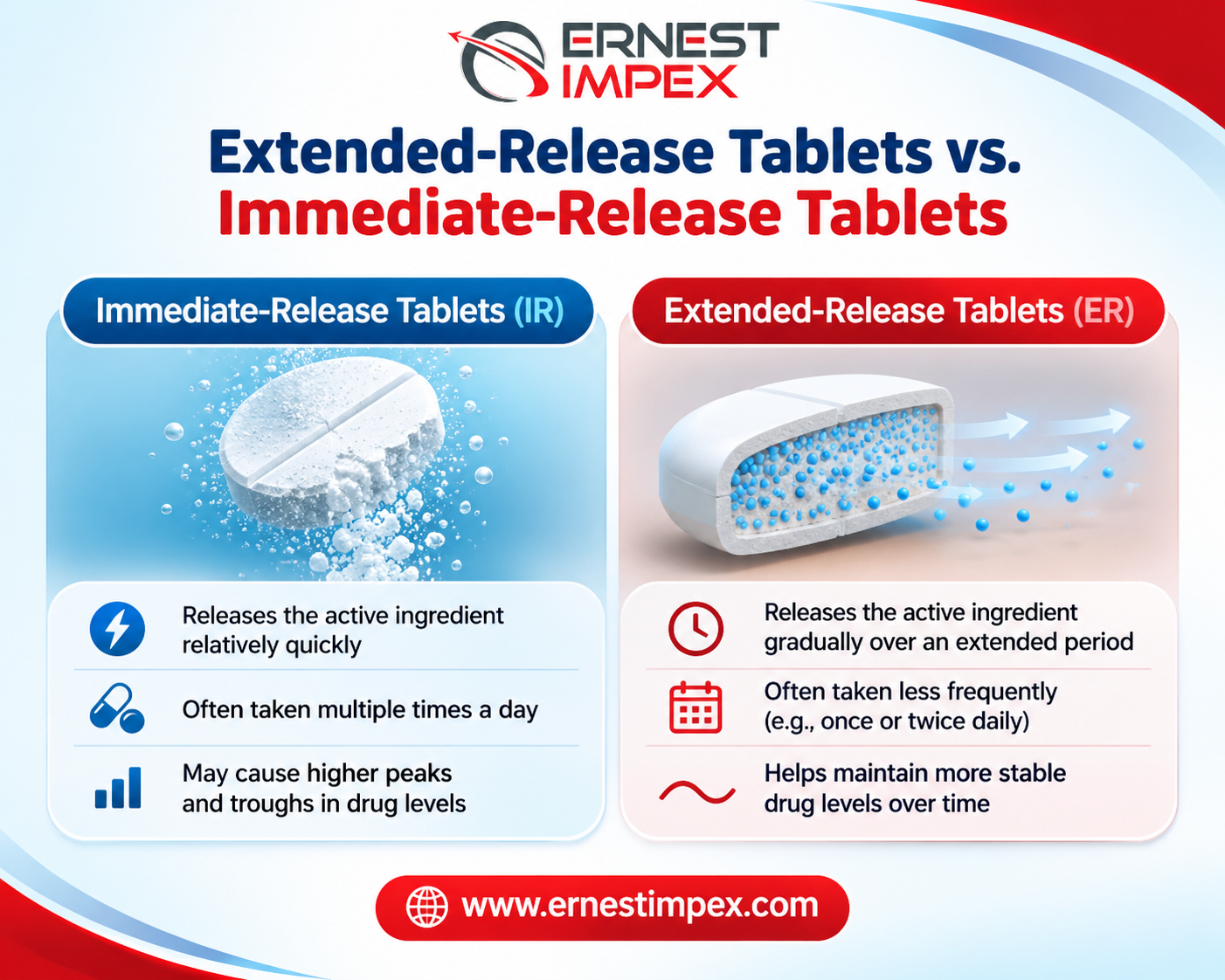
Two tablets may contain the same active ingredient and strength, yet behave differently after they are swallowed. The difference often lies in how the medicine is formulated to release its active ingredient. Extended release tablets are designed to release medication over a longer period, whereas immediate release tablets generally release their active ingredient without an intentional mechanism to prolong its release. Understanding this difference can help people read medicine labels correctly, recognize different pharmaceutical formulations, and understand why tablets containing the same ingredient are not always interchangeable.
What Are Extended Release Tablets?
Extended release tablets are oral pharmaceutical formulations developed to deliver an active ingredient over an extended period.
Instead of releasing the medicine in the same manner as a conventional tablet, these formulations use specialized materials or delivery systems to modify the release pattern. You may notice abbreviations such as ER, XR or XL next to a medicine's name. These commonly indicate an extended-release formulation, although the exact terminology varies between manufacturers.
Depending on the medicine, an extended-release formulation may reduce how frequently it needs to be taken or help reduce fluctuations in drug concentration. The actual duration of release depends on the individual product.
What Are Immediate Release Tablets?
Immediate-release tablets are conventional formulations that do not contain a specific mechanism intended to delay or extend the release of the active ingredient. After administration, the tablet generally breaks down, allowing the active ingredient to dissolve and become available for absorption. However, immediate release does not mean that a medicine starts working instantly. The time required for a medicine to produce an effect also depends on its absorption, metabolism, and pharmacological properties.
Immediate Release vs Extended Release: Key Differences
The main distinction between these formulations is their drug-release pattern.
| Feature | Immediate Release Tablets | Extended Release Tablets |
|---|---|---|
| Abbreviation | IR | ER, XR, or XL |
| Drug release | Conventional release pattern | Prolonged release pattern |
| Formulation | Usually conventional tablet design | Specialized drug-delivery design |
| Dosing frequency | May require more frequent administration | May allow less frequent administration |
| Duration of drug delivery | Generally shorter | Generally longer |
| Drug concentration | May show greater fluctuations | May reduce fluctuations |
| Crushing or splitting | Depends on the product | Often restricted |
| Interchangeability | Requires professional assessment | Requires professional assessment |
Neither formulation is automatically better than the other. Their suitability depends on the medicine, treatment requirements, and approved product information.
How Do Extended Release Tablets Work?
The release pattern of a tablet depends on more than its active ingredient. Its internal structure, coating, and inactive ingredients can also influence how the medicine becomes available for absorption. Several pharmaceutical technologies are used to develop modified-release formulations.
Matrix-Based Tablets
In a matrix system, the active ingredient is distributed throughout a specially designed material. When the tablet comes into contact with gastrointestinal fluids, the matrix may swell, gradually dissolve, or allow the drug to move through it. This structure helps regulate the release of the active ingredient.
Specialized Coating Systems
Some formulations use coatings that influence how quickly the medicine is released. The coating's composition and thickness can affect how gastrointestinal fluids interact with the tablet. Not every coated tablet is an extended-release product. Some coatings are intended to improve appearance, mask taste, or protect the medicine from particular environmental conditions.
Modified-Release Granules and Pellets
Certain pharmaceutical formulations contain small particles with individual release-controlling coatings. These particles can be incorporated into tablets or capsules to achieve a particular drug-release profile. The Specialist Pharmacy Service guidance on tablet formulations explains how matrices, coatings, and specially designed particles contribute to modified-release properties.
What Do IR, ER, XR, SR, and CR Mean in Medicines?
Medicine packaging often includes short abbreviations that describe the formulation.
These letters are important because they may distinguish products containing the same active ingredient.
| Abbreviation | Full Form | General Meaning |
|---|---|---|
| IR | Immediate Release | Conventional drug release |
| ER | Extended Release | Release over an extended period |
| XR | Extended Release | Alternative extended-release designation |
| XL | Extended Release | Common designation for longer-release formulations |
| SR | Sustained Release | Designed to sustain drug release |
| CR | Controlled Release | Designed to regulate the release pattern |
| PR | Prolonged Release | Extended duration of drug release |
| MR | Modified Release | General category covering altered release patterns |
| DR | Delayed Release | Drug release begins after an intended delay. |
These abbreviations describe general formulation characteristics. They do not establish that two products have identical release profiles or can be substituted for one another.
The complete medicine name and official product information should always be checked.
Sustained Release vs Extended Release Tablets
Sustained release and extended release are closely related pharmaceutical terms. Both describe formulations intended to prolong the release of an active ingredient compared with a conventional immediate-release product. In pharmaceutical literature, sustained release, prolonged release, and extended release are often used with overlapping meanings. However, individual products may use different technologies and have different release characteristics. The Australian Prescriber article on oral extended-release products discusses these formulation terms and the principles behind prolonged drug delivery. The abbreviation alone cannot tell a reader exactly how long a particular medicine releases its active ingredient.
Is Delayed Release the Same as Extended Release?
No. Although both belong to the broader category of modified-release formulations, they serve different purposes. A delayed-release tablet is designed to release its active ingredient after a particular delay or under specific conditions. An extended-release tablet is designed to prolong drug delivery. For example, an enteric-coated formulation may be designed to resist release in the stomach and release its contents further along the digestive tract. That does not necessarily mean the medicine will continue releasing its active ingredient for an extended period. This distinction is particularly useful when comparing pharmaceutical product specifications.
Immediate Release vs. Extended Release Metformin
Metformin is an example of an active ingredient available in both conventional and extended-release formulations. Although both formulations contain metformin, their pharmaceutical designs differ. The extended-release version is developed to modify the delivery of the active ingredient over time. The conventional formulation follows a different release pattern. The official metformin extended-release prescribing information on DailyMed illustrates why administration instructions are specific to the formulation.
Ernest Impex's oral antidiabetic medicine overview also illustrates how pharmaceutical product information identifies conventional and extended-release formulations separately.
Why Are Extended Release Tablets Developed?
The purpose of extended-release technology is to achieve a drug-delivery pattern suited to a particular therapeutic requirement.
Depending on the product, potential advantages may include:
A reduced frequency of administration.
More gradual delivery of the active ingredient.
Reduced fluctuations in drug concentration.
Greater convenience for certain long-term treatment schedules.
These advantages are product-specific. An extended-release formulation does not automatically provide better treatment results or fewer side effects. Its suitability must be established through appropriate pharmaceutical development and clinical evaluation.
Can Extended Release Tablets Be Crushed or Split?
This is an important consideration because the physical structure of a tablet may be responsible for its release characteristics. Crushing an extended-release tablet can damage the system that regulates drug delivery. In some cases, the alteration may cause the active ingredient to become available too quickly, increasing the risk of harmful effects. This problem is sometimes described as dose dumping. Certain modified-release tablets may be divided when their approved product information specifically permits it. Others must remain intact. A visible score line should not be treated as automatic permission to split a tablet. Anyone experiencing difficulty swallowing a medicine should consult a pharmacist or healthcare professional before changing how it is taken.
Are Extended Release Tablets Stronger Than Regular Tablets?
The strength printed on a medicine package indicates the amount of active ingredient contained in the dosage unit. The release designation describes how the formulation delivers that ingredient. For example, two hypothetical tablets may each contain 500 mg of the same active ingredient. One may be immediate release, while the other is extended release. Although their stated strengths are identical, their release profiles may differ. This is why medicine strength and release characteristics must be considered separately. A higher or lower release rate does not automatically make one formulation stronger, safer, or more effective.
How Pharmaceutical Buyers Identify the Correct Tablet Formulation
For wholesalers, distributors, and healthcare procurement teams, the release designation is an essential part of product identification. A procurement request that mentions only the active ingredient and strength may be incomplete when several formulations exist. Before confirming a product specification, buyers should review the following details.
| Product Detail | Reason for Checking |
|---|---|
| Active ingredient | Confirms the required pharmaceutical substance |
| Strength | Identifies the amount per dosage unit |
| Dosage form | Distinguishes tablets, capsules, and other preparations |
| Release type | Identifies IR, ER, SR, or other formulations |
| Manufacturer | Supports product identification and traceability |
| Product information | Confirms formulation-specific instructions |
| Regulatory status | Establishes applicable market eligibility |
| Quality documentation | Supports product specification verification |
The distinction between formulations also matters when comparing generic and branded products. Ernest Impex's article on generic vs branded medicines explains why buyers should consider dosage forms and release characteristics alongside active ingredients and strengths. For additional information about pharmaceutical product specifications and sourcing enquiries, readers can refer to the Ernest Impex frequently asked questions.
Frequently Asked Questions
Final Thoughts
Keywords