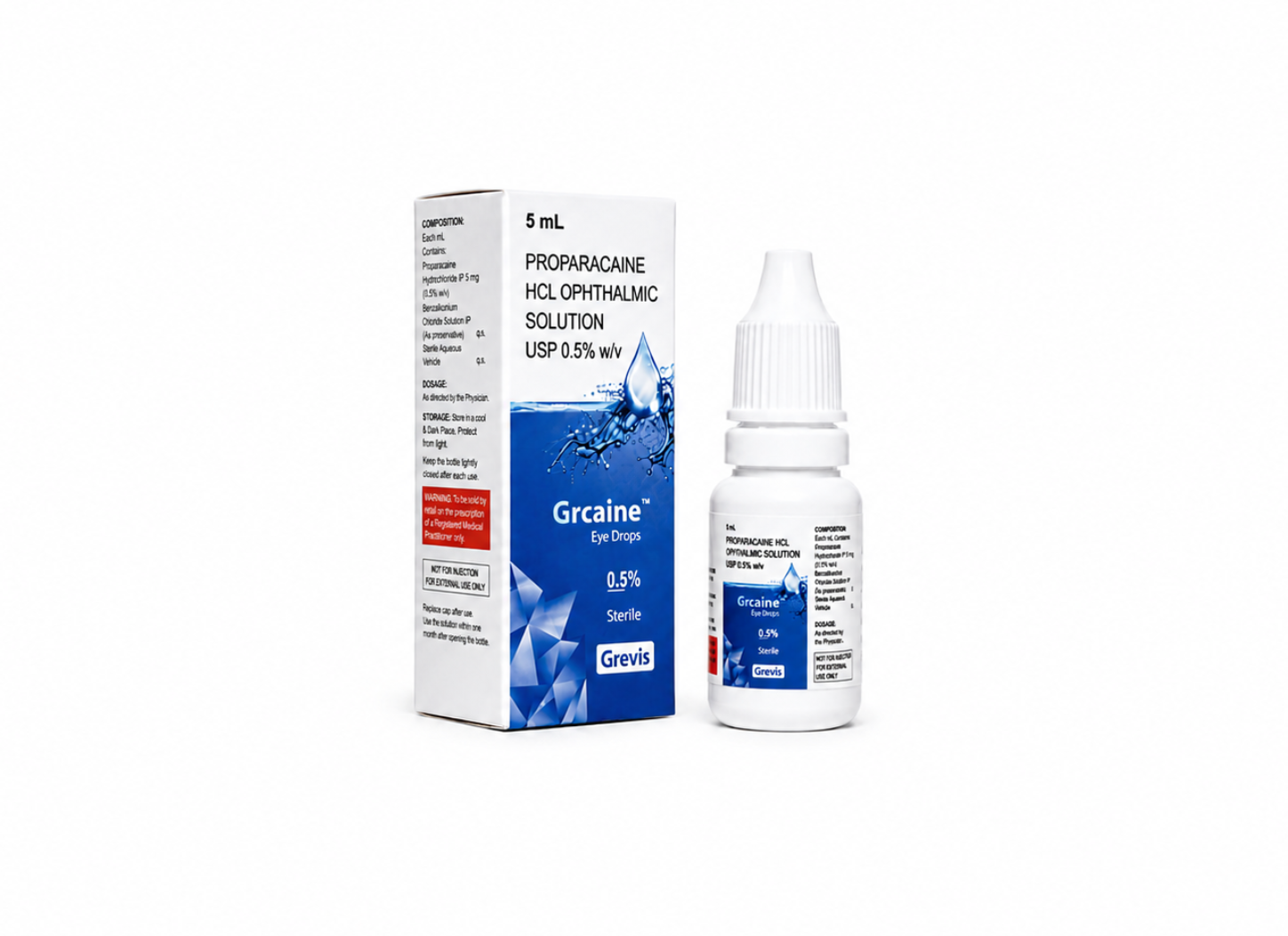
Grecaine Eye Drops: Advanced Topical Ophthalmic Anesthetic Therapy Extensive Product Profile: Understanding Grecaine Eye Drops
Grecaine Eye Drops contain Proparacaine Hydrochloride (typically formulated at a specialized clinical strength of 0.5% w/v). Manufactured to the highest global sterile pharmaceutical specifications, it is a fast-acting, short-duration local anesthetic of the ester classification. It is widely relied upon by ophthalmologists, optometrists, and ophthalmic surgeons to completely desensitize the corneal and conjunctival surfaces before performing brief clinical diagnostics, tonometry, or minor surgical manipulations.
1. Clinical Indications & Usage
Grecaine Eye Drops are a topical ophthalmic surface anesthetic globally indicated for:
Applanation Tonometry: Administered to temporarily eliminate the corneal blink reflex and desensitize the eye, allowing for accurate intraocular pressure (IOP) measurements.
Foreign Body and Suture Removal: Deployed to ensure localized anesthesia for the safe and swift removal of embedded corneal or conjunctival foreign bodies and surgical sutures.
Diagnostic Corneal Scrapings: Utilized to facilitate painless scrapings of the corneal epithelium for microbiological or cytological evaluations.
Preoperative Surgical Preparation: Instilled as a frontline topical prep-anesthetic before deeper ophthalmic interventions, including cataract extraction, pterygium excision, and laser refractive surgeries (such as LASIK or PRK).
2. Mechanism of Action: How Grecaine Works
Grecaine prevents the generation and conduction of nerve impulses locally through a targeted ion-channel pathway:
Sodium Channel Blockade: It binds competitively to specific receptor sites on voltage-gated sodium channels situated within the neuronal cell membrane of the ocular surface.
Inhibition of Depolarization: By blocking the influx of sodium ions, it effectively prevents the transient increase in membrane permeability to sodium that is normally required for neuronal depolarization.
Conduction Blockade: This action fails to propagate an action potential along the sensory nerve fibers of the cornea and conjunctiva, completely blocking the transmission of pain signals to the central nervous system.
Rapid Surface Desensitization: Because the corneal epithelium is highly vascularized with dense sensory nerve endings, direct topical contact produces profound, localized anesthesia within 20 seconds, persisting for approximately 15 minutes.
3. Administration and Dosing Guide
Administration Route: Grecaine is strictly intended for topical ophthalmic instillation into the conjunctival sac. It must never be injected subconjunctivally or introduced directly into the anterior chamber of the eye.
Standard Schedule: For minor diagnostic procedures, the standard dose is 1 to 2 drops instilled immediately before the assessment. For deep surgical procedures, 1 drop can be instilled every 5 to 10 minutes for up to 5 doses to extend the window of structural anesthesia.
Cross-Contamination Safeguards: To maintain mandatory sterility, the tip of the dropper must never touch the eye, eyelids, surrounding fingers, or any external surface.
⚠️ Safety, Side Effects, and Monitoring
Grecaine Eye Drops are a high-potency anesthetic agent requiring strict medical containment and supervision:
Strict Prohibition of Self-Administration: Grecaine is fundamentally unfit for home use or self-medication. Prolonged, unmonitored topical use can lead to permanent corneal epithelial breakdown, severe corneal ulceration, stromal infiltration, permanent visual loss, or total corneal opacification.
Corneal Vulnerability & Protection: While the ocular surface is completely anesthetized, the protective blink reflex is temporarily disabled. Patients must be strongly cautioned to avoid rubbing their eyes, touching the cornea, or exposing the eye to heavy dust and debris until the anesthetic effect completely wears off.
Delayed Hypersensitivity Reactions: Rare but serious localized allergic manifestations can occur, including acute chemical keratitis, diffuse epithelial stippling, severe conjunctival redness, and swelling of the eyelids (edema). Discontinue use immediately if an uncharacteristic inflammatory reaction is observed.
Common Side Effects: Transient stinging, mild burning, or conjunctival redness immediately following instillation; slight pupillary dilation (mydriasis) may occasionally occur.
📦 Storage and Handling Specifications
Storage Framework: Store Grecaine Eye Drops consistently within a climate-controlled cooling matrix between 2°C to 8°C (36°F to 46°F). Do not freeze.
Environmental Safeguards: Keep the dropper bottles sealed inside their original manufacturer cartons to protect the liquid from direct sunlight and UV radiation exposure. Proparacaine is highly prone to oxidation; if the solution discolors or turns a dark amber-brown, it must be discarded immediately. Once a bottle is opened, it must be used within 28 days and any remaining volume discarded. Keep strictly out of reach of children and unauthorized personnel.
📄 Regulatory and Compliance Documentation
Ernest Impex simplifies the complex international clearance process for global hospital networks, ambulatory surgery centers, and specialized pharmaceutical distributors by supplying an audit-ready compliance package with every dispatch:
Authentic Certificate of Analysis (COA)
Verified Batch Origin Ledger
Global Import Compliance Papers
PRESCRIPTION MEDICINE IS : YES
Clinical Disclaimer : This technical trade profile is compiled exclusively for international trade logistics, global wholesale procurement, and B2B search engine indexing. Grecaine Eye Drops are a high-potency clinical diagnostic agent available strictly under medical authorization (PRESCRIPTION MEDICINE IS YES). It must be handled, prepared, and administered solely by or under the direct supervision of a licensed ophthalmologist or optometrist. It is fundamentally contraindicated in patients presenting with a known history of severe hypersensitivity to proparacaine, ester-type local anesthetics, or any formulation stabilizers.
Why Choose Ernest Impex?
Sourcing through Ernest Impex ensures you receive professional-grade, secured supply-chain services:
Traceability
Regulatory Support
Secure Bulk Supply
📞 Contact Ernest Impex — Pharmaceutical Exporter from India
[GROUP OF ERNEST PHARMACEUTICAL PVT. LTD.]
🌐 Websites:
📧 Email:
📦 Business Type: Exporter | Bulk Supplier | Distributor
📲 WhatsApp: +91 93599 02383
📲 WhatsApp Link: