Hemp Seed Oil for Skin: Benefits, Uses, and Safety Guide
Hemp seed oil has become a familiar ingredient in skincare products, particularly among people looking for plant-based oils for their face and body. Its naturally occurring fatty acids make it an interesting option for skin conditioning and everyday moisturizing routines. But what benefits does hemp seed oil provide for the skin? Is it suitable for dry or oily skin? And is it the same as CBD oil? Hemp seed oil for skin is mainly used as a cosmetic oil to help soften the skin and support moisture retention. Although its composition is promising, research has not established it as a treatment for acne, eczema, psoriasis, or other skin conditions. This guide explains how cold-pressed hemp seed oil is produced, its potential skincare benefits, practical ways to use it, and important safety precautions.
What Is Hemp Seed Oil?
Hemp seed oil is a plant-derived oil obtained from the seeds of Cannabis sativa. The seeds contain natural fats, including omega-6 and omega-3 fatty acids. These contribute to the oil's use in cosmetic formulations and personal-care products. Hemp seed oil may be included in facial oils, body oils, creams, lotions and other skin-conditioning products. It is important to distinguish hemp seed oil from products containing cannabidiol (CBD). Both may originate from the same plant species, but they are made from different plant materials and have different compositions. The US Food and Drug Administration's information on hemp-derived ingredients explains that hemp seeds do not naturally contain CBD or THC, although trace contamination may occur during harvesting and processing.
What Does Cold-Pressed Hemp Seed Oil Mean?
Cold pressing is a mechanical extraction process used to obtain oil from seeds without relying on high-temperature extraction. In this process, pressure is applied to the seeds to release their oil. Cold-pressed hemp seed oil may retain characteristics such as its natural color, aroma, and fatty acid composition. However, the final quality also depends on the seeds, manufacturing practices, storage, and packaging. Cold pressing alone does not prove that a product is clinically effective, free from contaminants, or suitable for every skin type. The Vermont Agency of Agriculture's explanation of hemp seed oil describes how mechanically pressed seed oil differs from cannabinoid concentrates.
Hemp Seed Oil Composition: Why Fatty Acids Matter
The composition of hemp seed oil is one of the main reasons it is used in skincare.
It contains several fatty acids that are relevant to cosmetic formulation and skin conditioning.
| Fatty Acid | Type | Relevance to Skincare |
|---|---|---|
| Linoleic acid | Omega-6 polyunsaturated fatty acid | An important fatty acid associated with normal skin-barrier function |
| Alpha-linolenic acid | Omega-3 polyunsaturated fatty acid | Contributes to the oil's overall fatty acid profile |
| Oleic acid | Monounsaturated fatty acid | Influences the oil's texture and behavior in formulations |
| Palmitic acid | Saturated fatty acid | Contributes to the composition of the oil |
| Stearic acid | Saturated fatty acid | Commonly found in plant oils and cosmetic ingredients |
The exact proportions vary with plant variety, growing conditions, and processing.
A scientific review of bioactive compounds for skin health discusses fatty acids found in plant oils, including hemp oil, and their relevance to skin health. However, the presence of these ingredients does not automatically mean that applying hemp seed oil will produce a specific medical outcome.
Potential Benefits of Hemp Seed Oil for Skin
1. Helps Soften Dry-Feeling Skin
One of the most practical uses of hemp seed oil is as a skin-conditioning oil. Applying a suitable cosmetic oil can help soften the skin surface and reduce the feeling of roughness. For people whose skin feels dry after cleansing, a small amount of hemp seed oil may be used as part of a moisturising routine. The result depends on the overall skincare routine and individual skin response.
2. May Help Reduce Moisture Loss
Oils can form a thin layer on the skin surface that helps limit moisture loss. This is particularly relevant when skin feels tight or uncomfortable because of dryness. Hemp seed oil can be used alongside a moisturizer, although it does not replace every function of a complete moisturizing formulation. People with persistently dry or cracked skin may need products containing additional humectants and barrier-supporting ingredients.
3. Provides Fatty Acids Used in Skin-Conditioning Formulations
Hemp seed oil contains linoleic acid and other fatty acids that make it useful as an ingredient in cosmetic products. These components contribute to its formulation characteristics and may support skin conditioning. However, laboratory findings about individual fatty acids should not be interpreted as proof that pure hemp seed oil treats a particular skin disorder.
4. Offers a Plant-Based Facial Oil Option
Some people prefer simple, plant-derived ingredients in their skincare routine. Hemp seed oil can be one such option, particularly when the product is intended for external use and has an appropriate ingredient label. Nevertheless, natural origin does not guarantee that an ingredient is non-irritating or suitable for sensitive skin.
5. Can Be Used in Body-Care Routines
Hemp seed oil is not limited to facial skincare. Depending on the product's directions, it can also be used on dry areas of the body, such as the arms and legs. The aim is general skin conditioning rather than treating an underlying medical condition.
How to Use Hemp Seed Oil on Your Face
People interested in hemp seed oil for face care should first check that the specific product is suitable for topical application.
A simple approach is
Cleanse the face gently and pat the skin dry.
Follow the product label for the recommended amount and application method.
Apply a small amount to intact skin, avoiding the eyes and irritated areas.
Observe how the skin responds before making it a regular part of the routine.
Continue using an appropriate moisturizer and daytime sun protection.
A new skincare ingredient should be introduced gradually, particularly for people with reactive skin. Hemp seed oil is not a sunscreen and should not replace broad-spectrum sun protection.
Is Hemp Seed Oil Suitable for Dry, Oily, or Sensitive Skin?
Different skin types may respond differently to facial oils.
Hemp Seed Oil for Dry Skin
People with dry-feeling skin may appreciate the softening effect of an oil-based product. However, severe dryness, cracking or persistent itching may require a more comprehensive skincare approach or medical assessment.
Hemp Seed Oil for Oily Skin
Having oily skin does not automatically mean every facial oil must be avoided. However, some individuals may find that a particular oil leaves their skin feeling greasy or contributes to breakouts. There is not enough reliable evidence to guarantee that hemp seed oil will be non-comedogenic for everyone.
Hemp Seed Oil for Sensitive Skin
Sensitive skin can react to natural oils as well as synthetic ingredients. People with a history of contact allergies should be especially cautious and consider advice from a dermatologist before using unfamiliar products.
Can Hemp Seed Oil Help With Acne?
Acne is a medical skin condition involving several factors, including clogged follicles, oil production, inflammation, and microorganisms. Although hemp-derived ingredients have been investigated in skincare research, there is insufficient high-quality clinical evidence to establish plain hemp seed oil as an effective acne treatment. Some studies have investigated hemp-containing formulations, but these may contain additional ingredients and cannot necessarily be used to predict the effects of pure hemp seed oil. A 2024 review of hemp applications to the skin describes the emerging research while noting important limitations in clinical evidence. People with persistent or painful acne should use evidence-based treatments recommended by a healthcare professional rather than relying on cosmetic oil alone.
Can Hemp Seed Oil Treat Eczema or Psoriasis?
Eczema and psoriasis are different medical conditions that require appropriate diagnosis and management. Some research has explored hemp-derived products in relation to skin inflammation and barrier function. However, studies have used different formulations and routes of administration, and the evidence does not establish topical hemp seed oil as a proven treatment for either condition. A person with eczema or psoriasis may need suitable moisturizers and prescribed treatments depending on the severity of their symptoms. Hemp seed oil should not replace a dermatologist's recommended treatment plan.
Hemp Seed Oil vs CBD Oil: What Is the Difference?
The terms hemp seed oil, hemp oil and CBD oil are sometimes used loosely in online product descriptions.
They should not be treated as interchangeable.
| Feature | Hemp Seed Oil | CBD Oil |
|---|---|---|
| Main source | Hemp seeds | Cannabinoid-rich plant material |
| Principal components | Fatty acids | Cannabidiol in a carrier formulation |
| Typical cosmetic role | Skin conditioning and moisturizing | Depends on formulation and intended use |
| Naturally rich in CBD? | No | Contains CBD |
| Product evaluation | Check ingredients, quality, and intended use. | Check cannabinoid content, applicable rules and safety |
A hemp seed oil label does not, by itself, indicate that the product contains a meaningful amount of CBD. The FDA's guidance on cannabis-derived ingredients also makes clear that regulatory considerations differ between products and intended uses.
Side Effects and Safety Precautions
Many people may tolerate hemp seed oil when they use it appropriately, but adverse reactions are still possible.
Important precautions include:
Skin irritation: Discontinue use if burning, itching, or persistent redness occurs.
Allergic reactions: Avoid the product if you have a known allergy to its ingredients.
Patch testing: Test a small area before wider application, especially if your skin is sensitive.
Broken skin: Do not apply an unfamiliar cosmetic oil to open wounds or infected areas.
Product quality: Check the ingredient list, intended use, expiry date, and packaging condition.
Storage: Follow the manufacturer's instructions and protect the oil from conditions that may cause deterioration.
If swelling, breathing difficulty, or another severe allergic reaction occurs, seek urgent medical care.
What to Check Before Choosing Cold-Pressed Hemp Seed Oil
Not all products marketed as hemp oil have the same formulation.
Before choosing a product, review the following information:
| Product Detail | Why It Matters |
|---|---|
| Ingredient name | Helps confirm whether the product contains hemp seed oil or another hemp-derived ingredient |
| Extraction method | Identifies whether the oil is described as cold-pressed |
| Intended use | Clarifies whether it is suitable for skin application |
| Additional ingredients | Helps identify potential allergens or irritants |
| Batch and expiry details | Supports product identification and quality review |
| Storage instructions | Helps preserve the oil under recommended conditions |
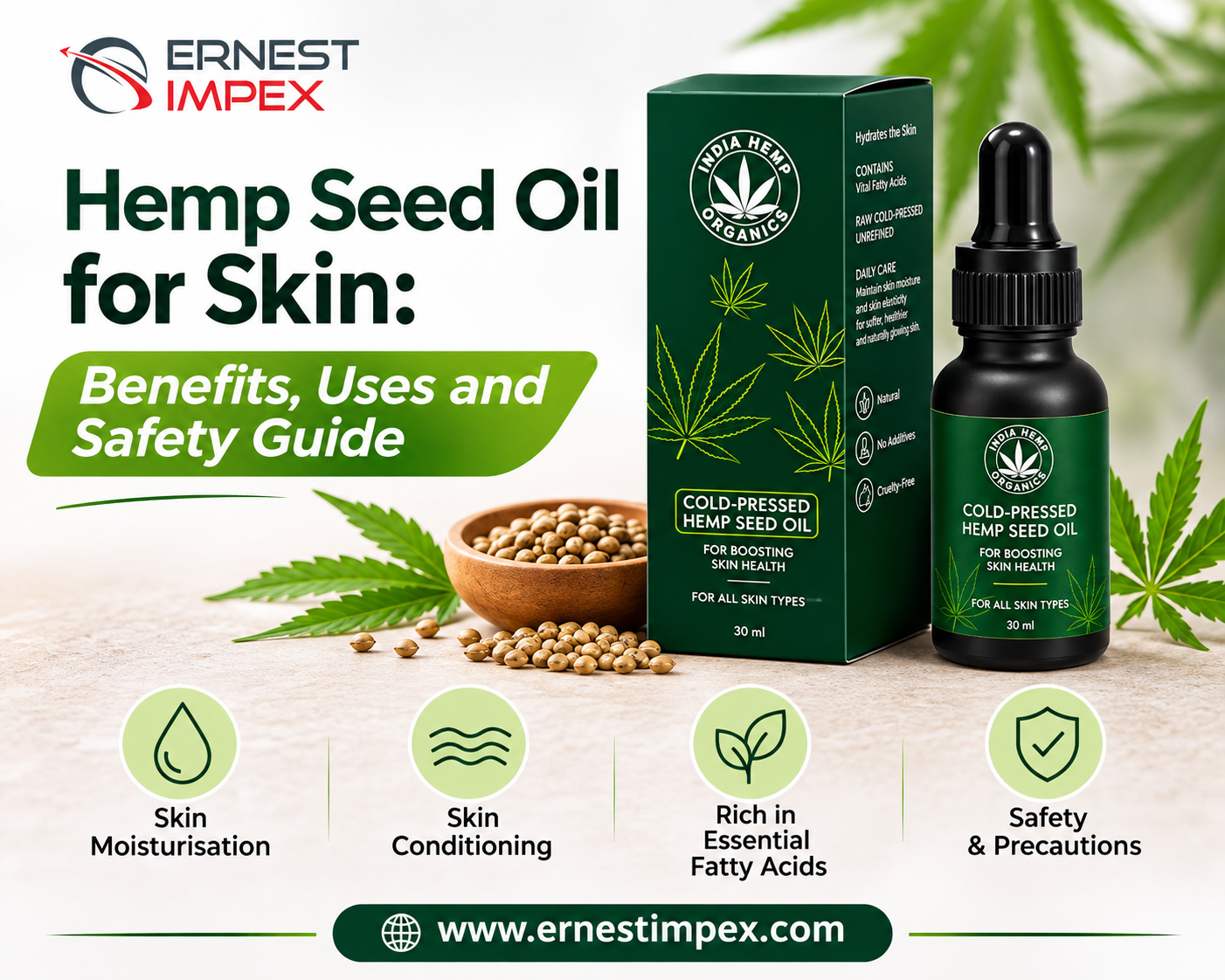
For example, the India Hemp Organics 30 ml bottle shown in the product image is labelled as cold-pressed hemp seed oil for skin health.
The package information should be checked before use. The label alone does not establish clinical effectiveness for any skin disease.
Readers reviewing pharmaceutical or personal-care product sourcing can also consult the Ernest Impex frequently asked questions for general information about product documentation and inquiries.
Frequently Asked Questions
1. What are the main benefits of hemp seed oil for skin?
Hemp seed oil is primarily used for skin conditioning and helping soften dry-feeling skin. Its fatty acid composition is of scientific interest, but many claimed therapeutic benefits still require stronger clinical evidence.
2. Can hemp seed oil be applied directly to the face?
A product intended for topical use may be applied according to its label instructions. Introduce it gradually and stop using it if irritation develops.
3. Is hemp seed oil good for dry skin?
It may help soften dry-feeling skin and reduce moisture loss as part of a suitable skincare routine. Persistent or severe dryness may need additional care.
4. Does hemp seed oil clog pores?
There is insufficient evidence to guarantee that it will not clog pores for every person. Individual skin response and the overall formulation matter.
5. Can hemp seed oil remove acne or acne scars?
There is no strong clinical evidence that plain hemp seed oil reliably treats acne or removes acne scars. Consult a dermatologist for persistent acne or scarring.
6. Is cold-pressed hemp seed oil better for skin?
Cold pressing describes an extraction method. It may help preserve certain characteristics of the oil, but it does not automatically make a product safer or more effective.
7. Does hemp seed oil contain CBD or THC?
Hemp seeds do not naturally contain meaningful amounts of CBD or THC. Trace amounts may be introduced during harvesting or processing, depending on product quality.
8. Can hemp seed oil replace a regular moisturizer?
It may complement a moisturizing routine, but a complete moisturizer may contain additional ingredients that help attract water and support the skin barrier.
Conclusion
Hemp seed oil for skin is best understood as a plant-derived cosmetic ingredient with a useful fatty acid profile and skin-conditioning properties. Cold-pressed hemp seed oil may be incorporated into face and body-care routines, particularly for people interested in moisturizing oils. However, claims that it cures acne, eczema, psoriasis, or other skin conditions go beyond the available clinical evidence. Choosing an appropriately labeled product, following its directions, and paying attention to individual skin reactions are more important than relying on exaggerated skincare claims.
Keywords