
Extensive Product Profile: Understanding Lox 2% Injection
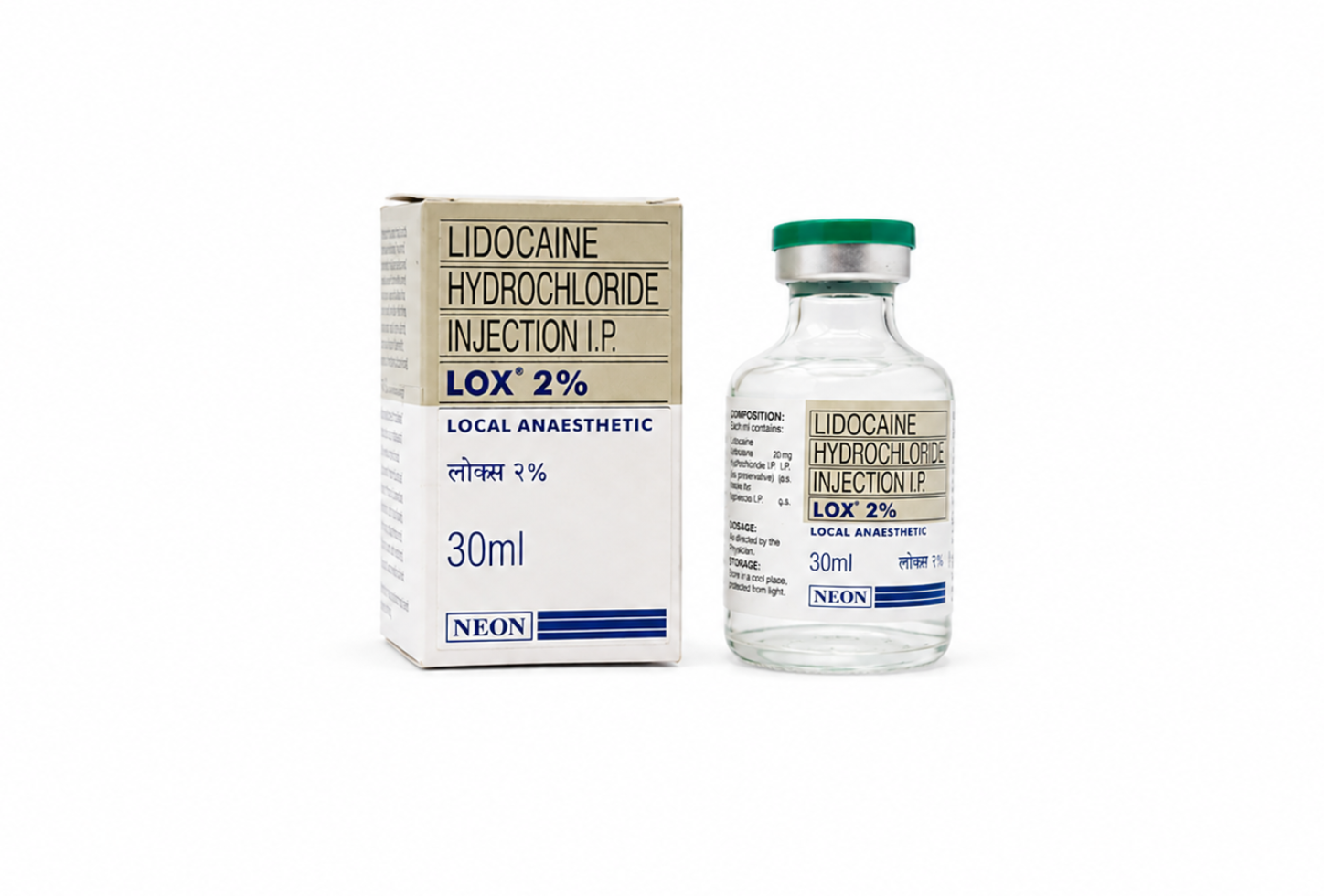
Lox 2% Injection contains lignocaine hydrochloride (also globally referred to as Lidocaine Hydrochloride) formulated at a strength of 20 mg/mL (2% w/v).
1. Clinical Indications & Usage
Lox 2% Injection is a parenteral targeted therapy globally indicated for:
Local & Regional Anesthesia: Administered via infiltration, peripheral nerve blocks, epidural blocks, or caudal anesthesia to temporarily abolish pain sensation during surgical, dental, diagnostic, or obstetric procedures.
Acute Ventricular Arrhythmias: Deployed intravenously (IV) for the immediate stabilization and management of life-threatening ventricular arrhythmias, such as those complicating acute myocardial infarction (heart attack), cardiac surgery, or digitalis toxicity.
Invasive Interventions: Used to mitigate pain and systemic stress responses during endotracheal intubation, specialized catheterizations, or diagnostic tissue aspirations.
2. Mechanism of Action: How Lox 2% Works
Lox 2% works through a highly specialized, dual-purpose molecular pathway based on its route of administration:
As a Local Anesthetic (Nerve Block):
It reversibly blocks voltage-gated sodium channels along the neuronal cell membrane.
By binding to specific receptor sites within the channel pore, it prevents the transient influx of sodium ions required for cell depolarization. This action completely halts the propagation of action potentials along local sensory nerve fibers, preventing pain signals from reaching the brain.
As a Class 1b Antiarrhythmic (Cardiac Action):
When administered intravenously, Lignocaine targets injured or ischemic myocardial tissues. It selectively binds to sodium channels during their inactivated state, decreasing the slope of Phase 4 depolarization and suppressing automaticity in the Purkinje fibers.
This shortens both the action potential duration and the effective refractory period, rapidly restoring normal sinus rhythm in hyper-irritable ventricles.
3. Administration and Dosing Guide
Administration Route: Lox 2% Injection is a highly versatile sterile solution. Depending on the clinical objective, it can be administered via subcutaneous infiltration, epidural space injection, perineural infiltration, or direct intravenous (IV) infusion.
Standard Schedule: Dosage must be individualized by clinical specialists based on the patient's weight, physical status, vascularity of the target tissue, and specific anesthetic technique. For standard local infiltration in an adult, the dose must not exceed 3 mg/kg of body weight when used without a vasoconstrictor (e.g., epinephrine).
Institutional Monitoring: For antiarrhythmic applications, administration must be performed under continuous electrocardiogram (ECG) tracking and hemodynamic monitoring.
⚠️ Safety, Side Effects, and Monitoring
Lox 2% Injection is a high-potency, systemic-acting agent requiring strict clinical containment.
Absolute Contraindications: Fundamentally contraindicated in patients with a known hypersensitivity to amide-type local anesthetics, severe hypovolemia, complete heart block, Stokes-Adams syndrome, or Wolff-Parkinson-White (WPW) syndrome.
Systemic Toxicity Risks (LAST): Accidental intravascular injection during regional blocks can lead to Local Anesthetic Systemic Toxicity (LAST).
Clinical staff must closely monitor for early signs of central nervous system (CNS) toxicity, such as a metallic taste, tinnitus (ringing in the ears), dizziness, perioral numbness, visual disturbances, or tremors, which can rapidly progress to generalized seizures and cardiovascular collapse.
Hepatic & Renal Clearence: Lignocaine is heavily metabolized by the liver via the cytochrome P450 enzyme system.
Patients with hepatic insufficiency, congestive heart failure, or severe renal impairment require substantial dose reductions due to prolonged half-life and toxicity risks.
Common Side Effects: Transient burning or redness at the injection site, mild lightheadedness, drowsiness, or minor fluctuations in blood pressure.
📦 Storage and Handling Specifications
Storage Framework: Store Lox 2% Injection at controlled room temperature below 30°C (86°F) in a secure, climate-controlled pharmaceutical facility. Do not freeze or expose to extreme heat.
Environmental Safeguards: Keep the single-dose ampoules or multi-dose vials sealed within their original manufacturer packaging to shield them from direct light. Inspect visually for particulate matter or discoloration prior to administration; the solution must remain clear and colorless. Keep strictly out of reach of children.
📄 Regulatory and Compliance Documentation
Ernest Impex streamlines international customs clearances and regulatory handovers for global medical institutions by delivering a comprehensive compliance package:
Authentic Certificate of Analysis (COA)
Verified Batch Origin Ledger
Global Import Compliance Papers
PRESCRIPTION MEDICINE IS : YES
Clinical Disclaimer & Contraindications: This profile is compiled strictly for global wholesale procurement, institutional healthcare logistics, and commercial trade research. Lox 2% Injection is a specialized critical-care therapeutic agent available exclusively under direct clinical authorization (PRESCRIPTION MEDICINE IS YES). It must be handled, prepared, and administered solely by or under the direct supervision of a licensed anesthesiologist, cardiologist, or registered healthcare practitioner.
Caution must be exercised if administered during pregnancy or breastfeeding, evaluating the clinical risk-to-benefit ratio.
Why Choose Ernest Impex?
Sourcing through Ernest Impex ensures you receive professional-grade, secured supply-chain services:
Traceability
Regulatory Support
Secure Bulk Supply
📞 Contact Ernest Impex — Pharmaceutical Exporter from India
[GROUP OF ERNEST PHARMACEUTICAL PVT. LTD.]
🌐 Websites:
📧 Email:
📦 Business Type: Exporter | Bulk Supplier | Distributor
📲 WhatsApp: +91 93599 02383
📲 WhatsApp Link: