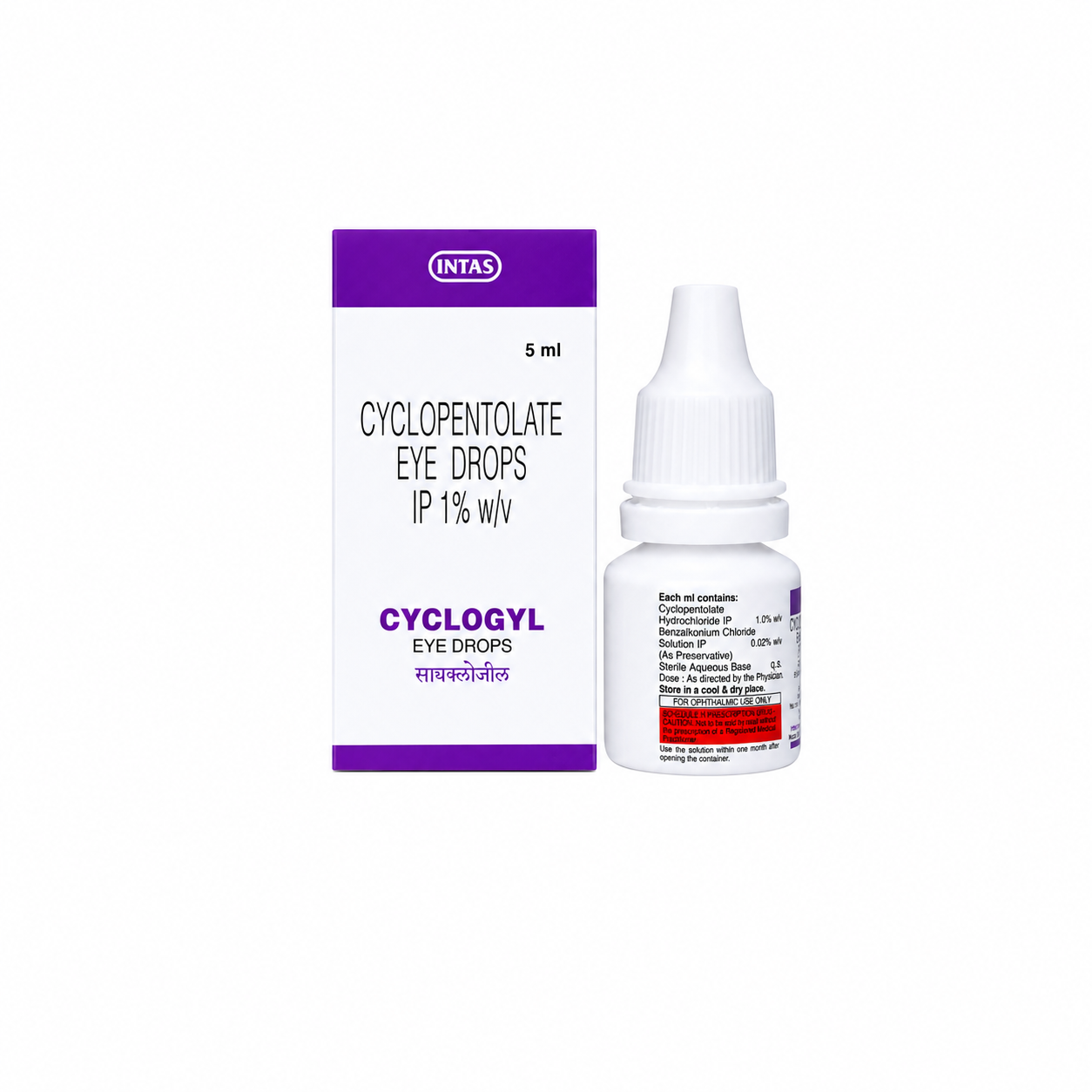
Cyclopentolate Hydrochloride 1% Eye Drop
Cyclopentolate Hydrochloride 1% Eye Drop is an ophthalmic medicine used to produce mydriasis and cycloplegia, meaning it helps dilate the pupil and temporarily relax the focusing muscles of the eye. It is commonly used before eye examination, refraction testing, retina examination, and selected diagnostic ophthalmic procedures.
This medicine is for topical ophthalmic use only and should be used under the supervision of an ophthalmologist or trained healthcare professional.
Product Information
| Attribute | Details |
|---|---|
| Product Name | Cyclopentolate Hydrochloride 1% Eye Drop |
| Generic Name | Cyclopentolate Hydrochloride |
| Strength | 1% |
| Dosage Form | Ophthalmic Solution / Eye Drops |
| Therapeutic Class | Ophthalmic Medicine |
| Drug Class | Anticholinergic / Mydriatic / Cycloplegic |
| Route of Administration | Eye use only |
| Common Use | Pupil dilation and cycloplegia |
| Prescription Required | Yes |
| Used Under | Ophthalmologist supervision |
Uses of Cyclopentolate Hydrochloride 1% Eye Drop
Cyclopentolate Hydrochloride 1% Eye Drop may be used for:
- Pupil dilation before eye examination
- Cycloplegic refraction testing
- Retina examination
- Fundus examination
- Diagnostic ophthalmic procedures
- Temporary relaxation of eye focusing muscles
- Selected pre-operative ophthalmic evaluation
- Specialist eye assessment in adults and children
Cyclopentolate is mainly used to dilate the pupil and stop the eye from focusing temporarily, which helps doctors examine the eye more accurately.
How Cyclopentolate Hydrochloride Eye Drop Works
Cyclopentolate is an anticholinergic eye medicine. It blocks certain nerve signals in the eye, which relaxes the iris and ciliary muscles. This causes the pupil to widen and temporarily prevents the eye from focusing clearly.
This effect helps the ophthalmologist check the inside of the eye, measure refractive error, and perform diagnostic procedures.
Dosage and Administration
Cyclopentolate Hydrochloride 1% Eye Drop should be used exactly as advised by the doctor.
General instructions:
- Use only in the eyes.
- Wash hands before and after use.
- Do not touch the dropper tip to the eye or any surface.
- Apply the number of drops advised by the doctor.
- Keep eyes closed for a short time after application.
- Remove contact lenses before using if advised.
- Vision may become blurred temporarily.
- Avoid driving or operating machinery until vision becomes clear.
Cyclopentolate eye drops are not for injection and should not be swallowed. Some labels mention that adults may receive one or two drops, repeated after a few minutes if needed, but the final dose must be decided by the eye specialist.
Common Side Effects
Common side effects may include:
- Temporary blurred vision
- Burning or stinging sensation
- Eye irritation
- Redness
- Sensitivity to light
- Dry mouth
- Temporary difficulty focusing
- Headache
Blurred vision and sensitivity to light are common after cyclopentolate use and may last for several hours.
Serious Side Effects
Contact a doctor immediately if you notice:
- Severe eye pain
- Severe redness
- Swelling around eyes
- Allergic reaction
- Fast heartbeat
- Confusion or unusual behavior
- Fever
- Difficulty urinating
- Breathing difficulty
- Vision worsening
Rare systemic side effects may occur, especially in younger patients or sensitive individuals.
Precautions Before Use
Before using Cyclopentolate Hydrochloride 1% Eye Drop, inform your doctor if you have:
- Glaucoma
- Narrow-angle glaucoma risk
- High eye pressure
- Eye infection
- Heart disease
- High blood pressure
- Down syndrome or neurological condition
- Allergy to cyclopentolate
- Pregnancy or breastfeeding condition
- Recent eye surgery history
Cyclopentolate should not be used in patients with untreated narrow-angle glaucoma or narrow angles unless specifically advised by an ophthalmologist.
Storage Information
Store Cyclopentolate Hydrochloride 1% Eye Drop as per the product label instructions. Keep the bottle tightly closed, away from direct sunlight, heat, and moisture. Keep out of reach of children.
FAQ – Cyclopentolate Hydrochloride 1% Eye Drop
1. What is Cyclopentolate Hydrochloride 1% Eye Drop?
Cyclopentolate Hydrochloride 1% Eye Drop is an ophthalmic medicine used for pupil dilation and cycloplegia during eye examinations.
2. What is Cyclopentolate Eye Drop used for?
It is used to dilate the pupil, relax the focusing muscles of the eye, and help doctors perform eye examinations and diagnostic procedures.
3. Is Cyclopentolate Hydrochloride 1% an antibiotic?
No, Cyclopentolate is not an antibiotic. It is a mydriatic and cycloplegic eye drop.
4. Is Cyclopentolate used for eye infection?
No, it is not used to treat eye infection. It is mainly used for pupil dilation and eye testing.
5. How does Cyclopentolate Eye Drop work?
It relaxes certain muscles in the eye, causing pupil dilation and temporary loss of focusing ability.
6. Can Cyclopentolate Eye Drop cause blurred vision?
Yes, temporary blurred vision is common after using Cyclopentolate Eye Drop.
7. Can Cyclopentolate cause light sensitivity?
Yes, the eyes may become sensitive to light after use because the pupils remain dilated.
8. Can I drive after using Cyclopentolate Eye Drop?
Avoid driving until your vision becomes normal again.
9. How long does Cyclopentolate effect last?
The effect may last for several hours, and in some cases pupil dilation or blurred vision may continue up to 24 hours or more.
10. Is Cyclopentolate Eye Drop safe?
It is generally safe when used correctly under medical supervision, but side effects and allergic reactions can occur.