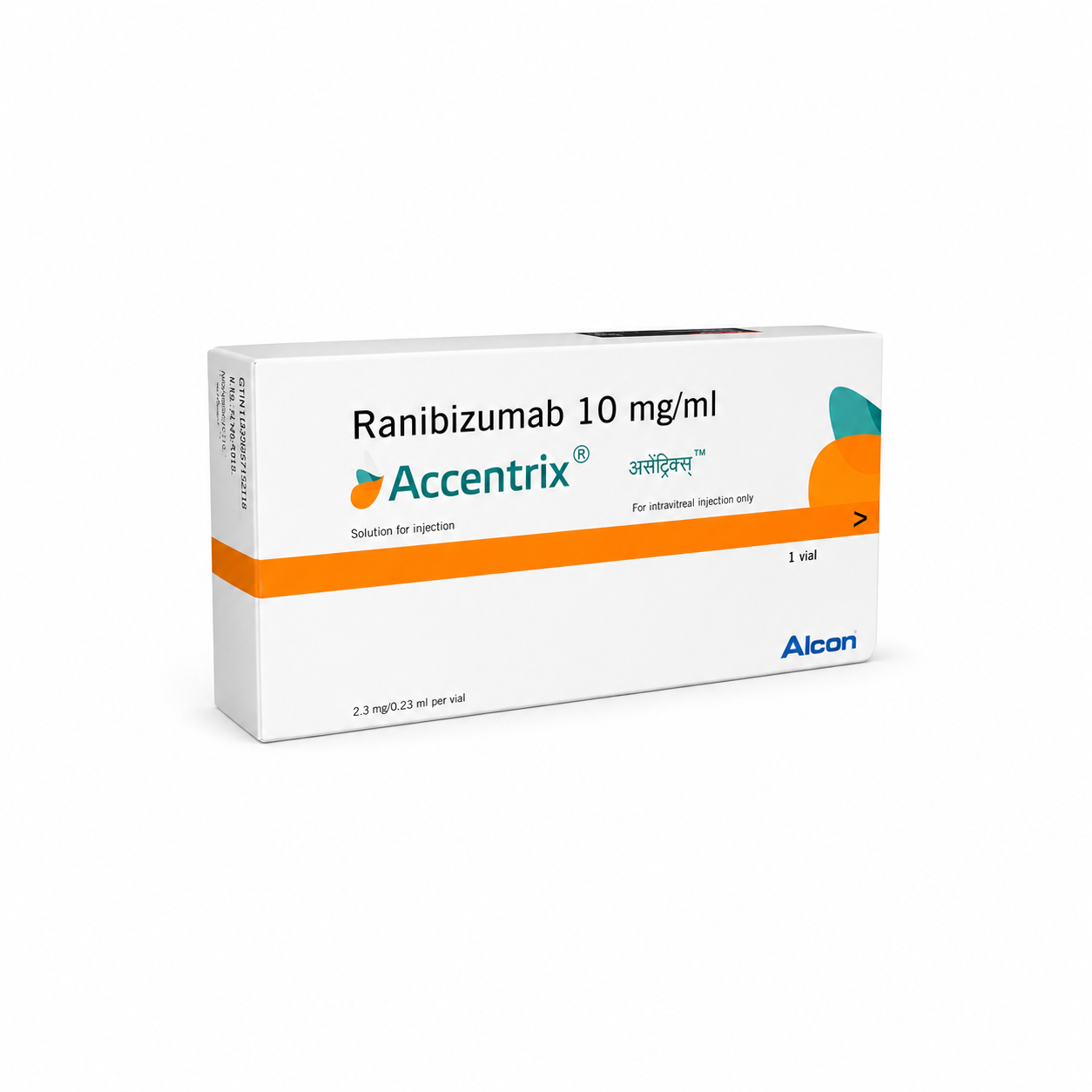
Accentrix 10 mg/ml Injection
Accentrix 10 mg/ml Injection is an ophthalmic injection containing Ranibizumab 10 mg/ml. Ranibizumab is an anti-VEGF medicine used by retina specialists for selected retinal diseases involving abnormal blood vessel growth, leakage, or swelling inside the eye. Accentrix is listed as a ranibizumab product used for eye diseases caused by diabetes, macular degeneration, and macular swelling.
This medicine is administered as an intravitreal injection, meaning it is injected directly into the vitreous cavity of the eye by a trained ophthalmologist or retina specialist.
Composition & Product Details
Product Name: Accentrix 10 mg/ml Injection
Composition: Ranibizumab 10 mg/ml
Medicine Category: Ophthalmic / Anti-VEGF Injection
Dosage Form: Solution for Injection
Route: Intravitreal injection
Common Use: Retinal diseases involving abnormal blood vessel growth or retinal swelling
Supplier/Exporter: Ernest Impex
Ranibizumab 10 mg/ml products are commonly supplied as sterile, preservative-free solutions for intravitreal use. One ranibizumab 10 mg/ml product reference states that each vial contains ranibizumab solution intended to deliver a single 0.05 ml dose containing 0.5 mg ranibizumab.
Clinical Indications & Usage
Accentrix 10 mg/ml Injection may be used by ophthalmologists for retinal conditions such as:
- Wet age-related macular degeneration
- Diabetic macular edema
- Diabetic eye disease-related retinal swelling
- Retinal vein occlusion-related macular edema
- Other retinal conditions as advised by a retina specialist
Ranibizumab injection is used for serious retinal diseases associated with abnormal blood vessel growth and fluid leakage, and sources list its use in wet AMD, diabetic macular edema, and retinal swelling.
How Accentrix 10 mg/ml Injection Works
Accentrix contains Ranibizumab, a vascular endothelial growth factor-A antagonist. It works by binding to VEGF-A, a protein involved in abnormal blood vessel growth and leakage in the retina. By blocking VEGF-A, ranibizumab helps reduce abnormal vessel growth, retinal leakage, and swelling.
This action helps stabilize or improve vision in selected retinal conditions when used as part of a specialist treatment plan.
Administration and Dosage Guide
Accentrix 10 mg/ml Injection should be administered only by a qualified ophthalmologist or retina specialist. The injection is given into the eye under sterile conditions.
The treatment schedule depends on:
- Type of retinal disease
- Vision status
- Retinal scan/OCT findings
- Doctor’s treatment plan
- Patient response to therapy
- Follow-up examination results
Do not self-administer this medicine. It must be handled and injected only by trained eye-care professionals.
Safety, Side Effects & Monitoring
Possible side effects may include:
- Eye discomfort
- Eye redness
- Watery eyes
- Temporary blurred vision
- Increased eye pressure
- Floaters
- Eye pain
- Eye irritation
- Infection risk
- Inflammation inside the eye
Intravitreal anti-VEGF injections require careful sterile technique and monitoring by a specialist because rare but serious eye complications can occur. Real-world evidence on intravitreal ranibizumab biosimilar use reported no new ocular or systemic safety concerns, but treatment should still be specialist-supervised.
Precautions
Use Accentrix 10 mg/ml Injection carefully if the patient has:
- Active eye infection
- Eye inflammation
- Recent eye surgery
- Glaucoma or high eye pressure
- History of stroke or heart disease
- Pregnancy or breastfeeding condition
- Allergy to ranibizumab or injection ingredients
Storage and Handling
- Store as per product label instructions
- Keep away from direct sunlight
- Do not freeze unless label permits
- Keep in original packaging
- Use only if solution is clear and vial is intact
- Keep away from children
- Do not use after expiry date
- Maintain sterile handling before administration
FAQ
1. What is Accentrix 10 mg/ml Injection used for?
Accentrix 10 mg/ml Injection is used by retina specialists for selected retinal diseases such as wet age-related macular degeneration, diabetic macular edema, and retinal swelling.
2. What is the composition of Accentrix Injection?
Accentrix 10 mg/ml Injection contains Ranibizumab 10 mg/ml.
3. Is Accentrix an anti-VEGF injection?
Yes. Accentrix contains ranibizumab, which is an anti-VEGF ophthalmic medicine.
4. How does Accentrix 10 mg/ml Injection work?
It blocks VEGF-A, a protein involved in abnormal blood vessel growth and leakage inside the retina.
5. How is Accentrix Injection given?
It is given as an intravitreal injection directly into the eye by a trained ophthalmologist or retina specialist.
6. Can Accentrix Injection be self-administered?
No. It must never be self-administered. It should be injected only by a qualified eye specialist.
7. Is Accentrix used for diabetic eye disease?
Yes, ranibizumab injections may be used for diabetic macular edema and diabetic eye disease-related retinal swelling under specialist care.
8. Is Accentrix used for macular degeneration?
Yes, it may be used for wet age-related macular degeneration as advised by an ophthalmologist.
9. What are common side effects of Accentrix Injection?
Common effects may include eye discomfort, redness, watery eyes, temporary blurred vision, floaters, eye irritation, or increased eye pressure.
10. Can Accentrix Injection cause eye infection?
Eye infection is a rare but serious risk with intravitreal injections, which is why sterile specialist administration is required.